CEED
  • SAMUELI
  • ABOUT
    • Latest News
    • Student Spotlights
    • Alumni Highlights
    • Testimonials
    • Leadership and Staff
    • Contact
    • Archives and Newsletters
  • APPLY
  • UNDERGRADUATE
    • Overview
    • CEED University and Corporate Scholarships
    • Campus Resources
    • 2025 SURE@UCLA
    • CEED Mentoring Program
    • GEM Fellowship Information
  • PRE-COLLEGE
    • Overview
    • MESA
      • MESA Homepage
      • Resources
    • MAP
      • MAP General Info
  • INDUSTRY
    • Join IAB
    • Industry Partners
    • IAB Materials
  • DONATE
Select Page

Black History Month 2023 Highlights
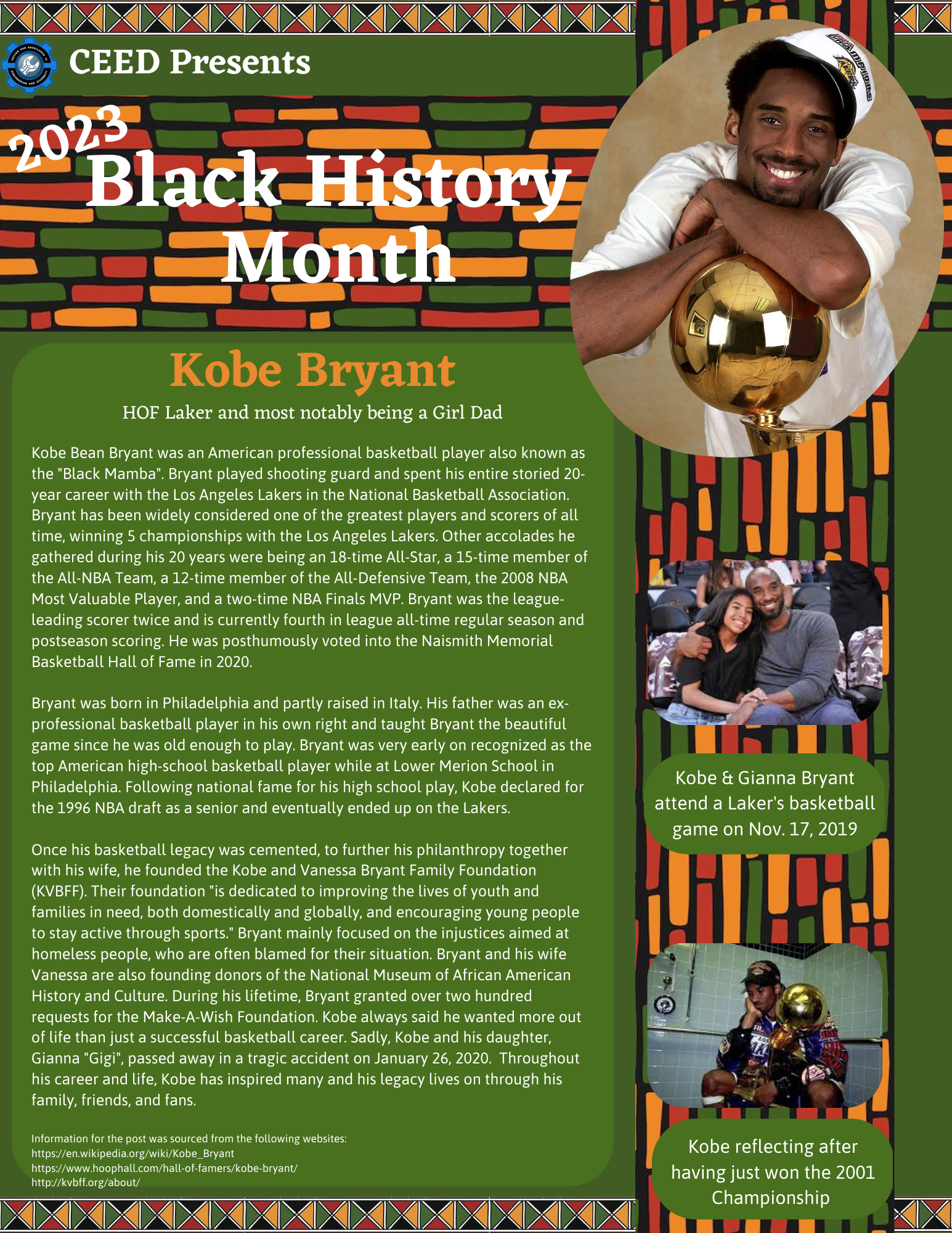
Black History Month Flyer for Kobe Bryant. Contains images and the following text: Kobe Bean Bryant was an American professional basketball player also known as the "Black Mamba". Bryant played shooting guard and spent his entire storied 20- year career with the Los Angeles Lakers in the National Basketball Association. Bryant has been widely considered one of the greatest players and scorers of all time, winning 5 championships with the Los Angeles Lakers. Other accolades he gathered during his 20 years were being an 18-time All-Star, a 15-time member of the All-NBA Team, a 12-time member of the All-Defensive Team, the 2008 NBA Most Valuable Player, and a two-time NBA Finals MVP. Bryant was the leagueleading scorer twice and is currently fourth in league all-time regular season and postseason scoring. He was posthumously voted into the Naismith Memorial Basketball Hall of Fame in 2020. Bryant was born in Philadelphia and partly raised in Italy. His father was an exprofessional basketball player in his own right and taught Bryant the beautiful game since he was old enough to play. Bryant was very early on recognized as the top American high-school basketball player while at Lower Merion School in Philadelphia. Following national fame for his high school play, Kobe declared for the 1996 NBA draft as a senior and eventually ended up on the Lakers. Once his basketball legacy was cemented, to further his philanthropy together with his wife, he founded the Kobe and Vanessa Bryant Family Foundation (KVBFF). Their foundation "is dedicated to improving the lives of youth and families in need, both domestically and globally, and encouraging young people to stay active through sports." Bryant mainly focused on the injustices aimed at homeless people, who are often blamed for their situation. Bryant and his wife Vanessa are also founding donors of the National Museum of African American History and Culture. During his lifetime, Bryant granted over two hundred requests for the Make-A-Wish Foundation. Kobe always said he wanted more out of life than just a successful basketball career. Sadly, Kobe and his daughter, Gianna "Gigi", passed away in a tragic accident on January 26, 2020. Throughout his career and life, Kobe has inspired many and his legacy lives on through his family, friends, and fans. Information for the post was sourced from the following websites: https://en.wikipedia.org/wiki/Kobe_Bryant https://www.hoophall.com/hall-of-famers/kobe-bryant/ http://kvbff.org/about/
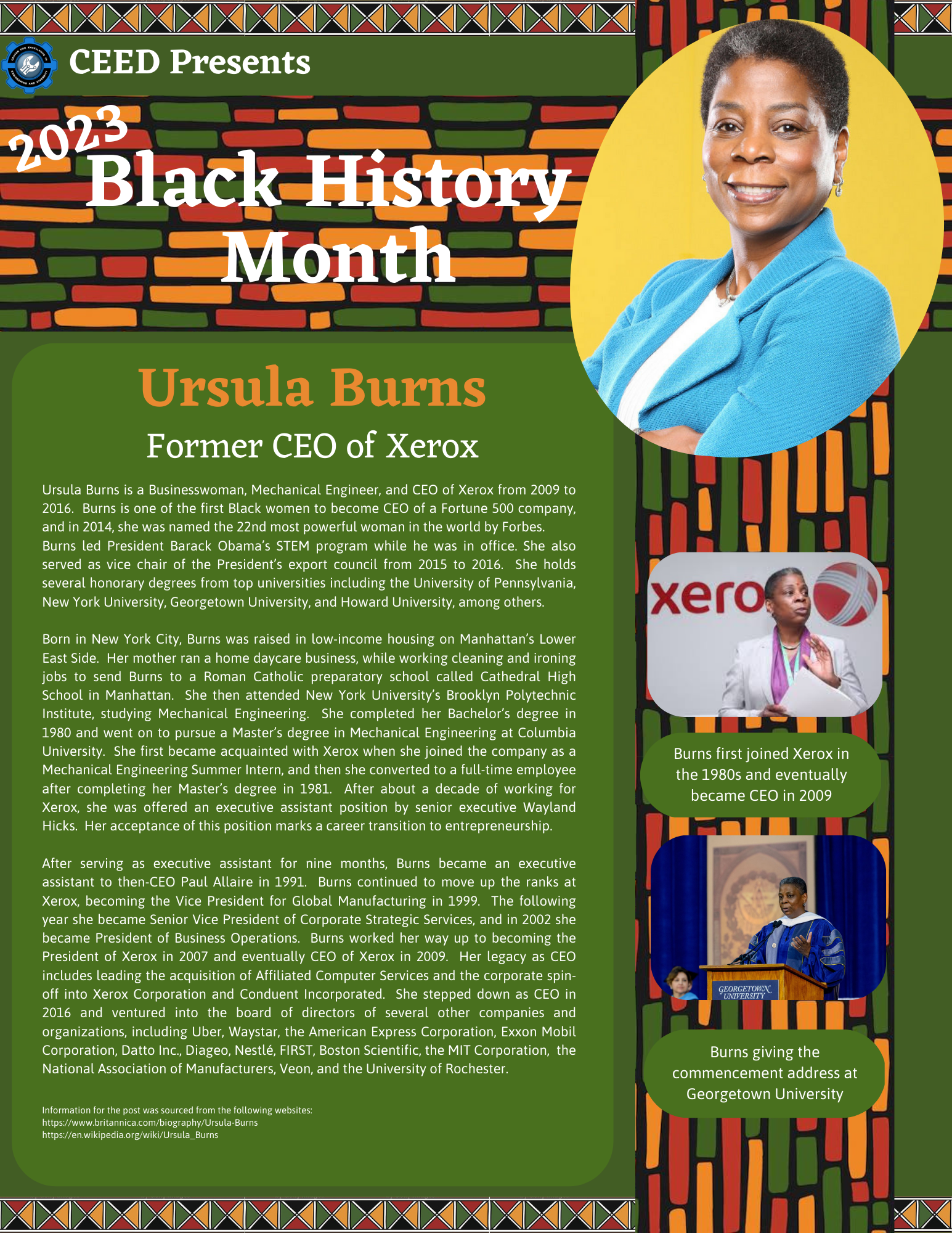
Black History Month Flyer for Ursula Burns. Contains the following information: Ursula Burns is a Businesswoman, Mechanical Engineer, and CEO of Xerox from 2009 to 2016. Burns is one of the first Black women to become CEO of a Fortune 500 company, and in 2014, she was named the 22nd most powerful woman in the world by Forbes. Burns led President Barack Obama’s STEM program while he was in office. She also served as vice chair of the President’s export council from 2015 to 2016. She holds several honorary degrees from top universities including the University of Pennsylvania, New York University, Georgetown University, and Howard University, among others. Born in New York City, Burns was raised in low-income housing on Manhattan’s Lower East Side. Her mother ran a home daycare business, while working cleaning and ironing jobs to send Burns to a Roman Catholic preparatory school called Cathedral High School in Manhattan. She then attended New York University’s Brooklyn Polytechnic Institute, studying Mechanical Engineering. She completed her Bachelor’s degree in 1980 and went on to pursue a Master’s degree in Mechanical Engineering at Columbia University. She first became acquainted with Xerox when she joined the company as a Mechanical Engineering Summer Intern, and then she converted to a full-time employee after completing her Master’s degree in 1981. After about a decade of working for Xerox, she was offered an executive assistant position by senior executive Wayland Hicks. Her acceptance of this position marks a career transition to entrepreneurship. After serving as executive assistant for nine months, Burns became an executive assistant to then-CEO Paul Allaire in 1991. Burns continued to move up the ranks at Xerox, becoming the Vice President for Global Manufacturing in 1999. The following year she became Senior Vice President of Corporate Strategic Services, and in 2002 she became President of Business Operations. Burns worked her way up to becoming the President of Xerox in 2007 and eventually CEO of Xerox in 2009. Her legacy as CEO includes leading the acquisition of Affiliated Computer Services and the corporate spin-off into Xerox Corporation and Conduent Incorporated. She stepped down as CEO in 2016 and ventured into the board of directors of several other companies and organizations, including Uber, Waystar, the American Express Corporation, Exxon Mobil Corporation, Datto Inc., Diageo, Nestlé, FIRST, Boston Scientific, the MIT Corporation, the National Association of Manufacturers, Veon, and the University of Rochester. Information for the post was sourced from the following websites: https://www.britannica.com/biography/Ursula-Burns https://en.wikipedia.org/wiki/Ursula_Burns
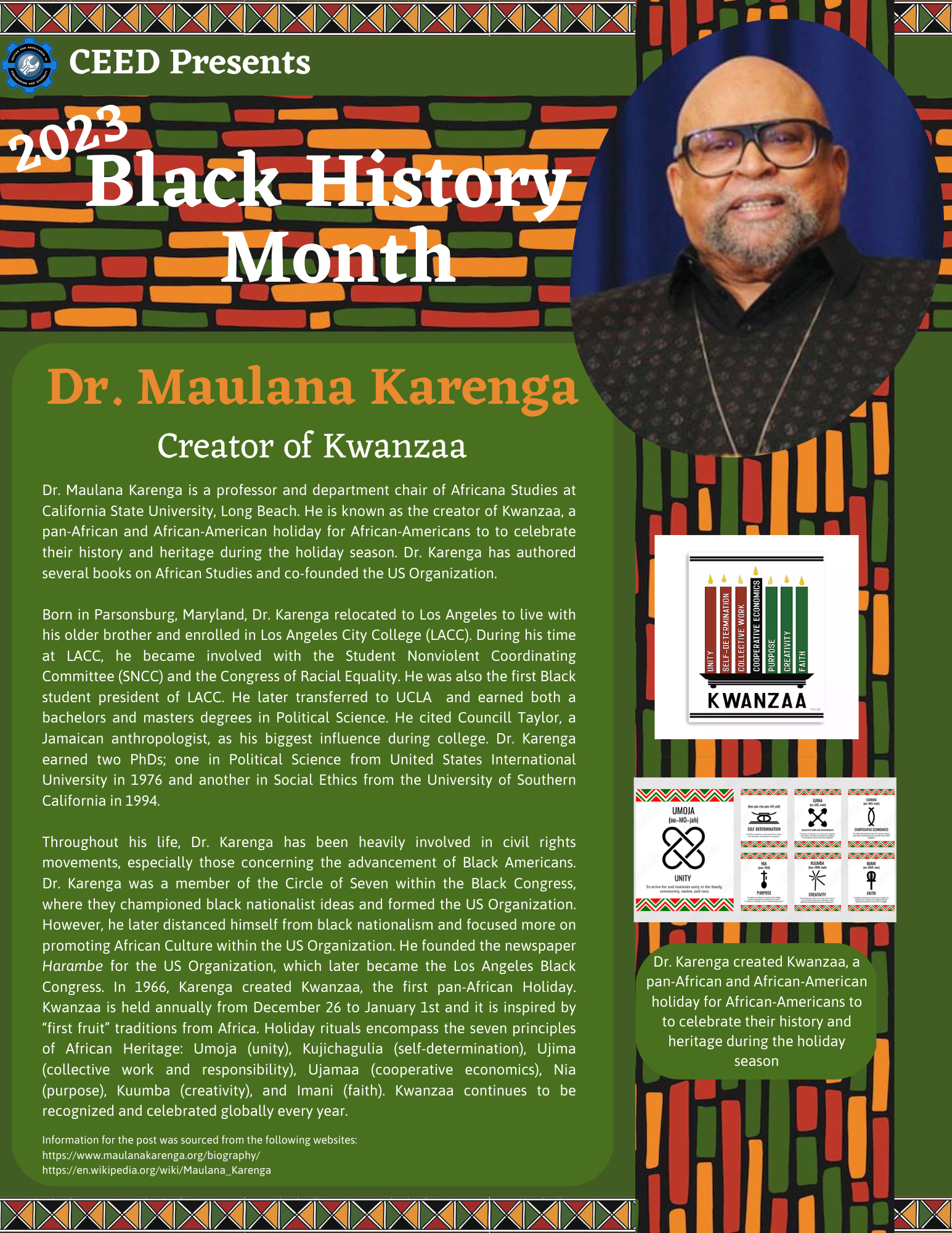
Black History Month Flyer for Dr. Maulana Karenga. Contains the following information: Dr. Maulana Karenga is a professor and department chair of Africana Studies at California State University, Long Beach. He is known as the creator of Kwanzaa, a pan-African and African-American holiday for African-Americans to to celebrate their history and heritage during the holiday season. Dr. Karenga has authored several books on African Studies and co-founded the US Organization. Born in Parsonsburg, Maryland, Dr. Karenga relocated to Los Angeles to live with his older brother and enrolled in Los Angeles City College (LACC). During his time at LACC, he became involved with the Student Nonviolent Coordinating Committee (SNCC) and the Congress of Racial Equality. He was also the first Black student president of LACC. He later transferred to UCLA and earned both a bachelors and masters degrees in Political Science. He cited Councill Taylor, a Jamaican anthropologist, as his biggest influence during college. Dr. Karenga earned two PhDs; one in Political Science from United States International University in 1976 and another in Social Ethics from the University of Southern California in 1994. Throughout his life, Dr. Karenga has been heavily involved in civil rights movements, especially those concerning the advancement of Black Americans. Dr. Karenga was a member of the Circle of Seven within the Black Congress, where they championed black nationalist ideas and formed the US Organization. However, he later distanced himself from black nationalism and focused more on promoting African Culture within the US Organization. He founded the newspaper Harambe for the US Organization, which later became the Los Angeles Black Congress. In 1966, Karenga created Kwanzaa, the first pan-African Holiday. Kwanzaa is held annually from December 26 to January 1st and it is inspired by “first fruit” traditions from Africa. Holiday rituals encompass the seven principles of African Heritage: Umoja (unity), Kujichagulia (self-determination), Ujima (collective work and responsibility), Ujamaa (cooperative economics), Nia (purpose), Kuumba (creativity), and Imani (faith). Kwanzaa continues to be recognized and celebrated globally every year. Information for the post was sourced from the following websites: https://www.maulanakarenga.org/biography/ https://en.wikipedia.org/wiki/Maulana_Karenga
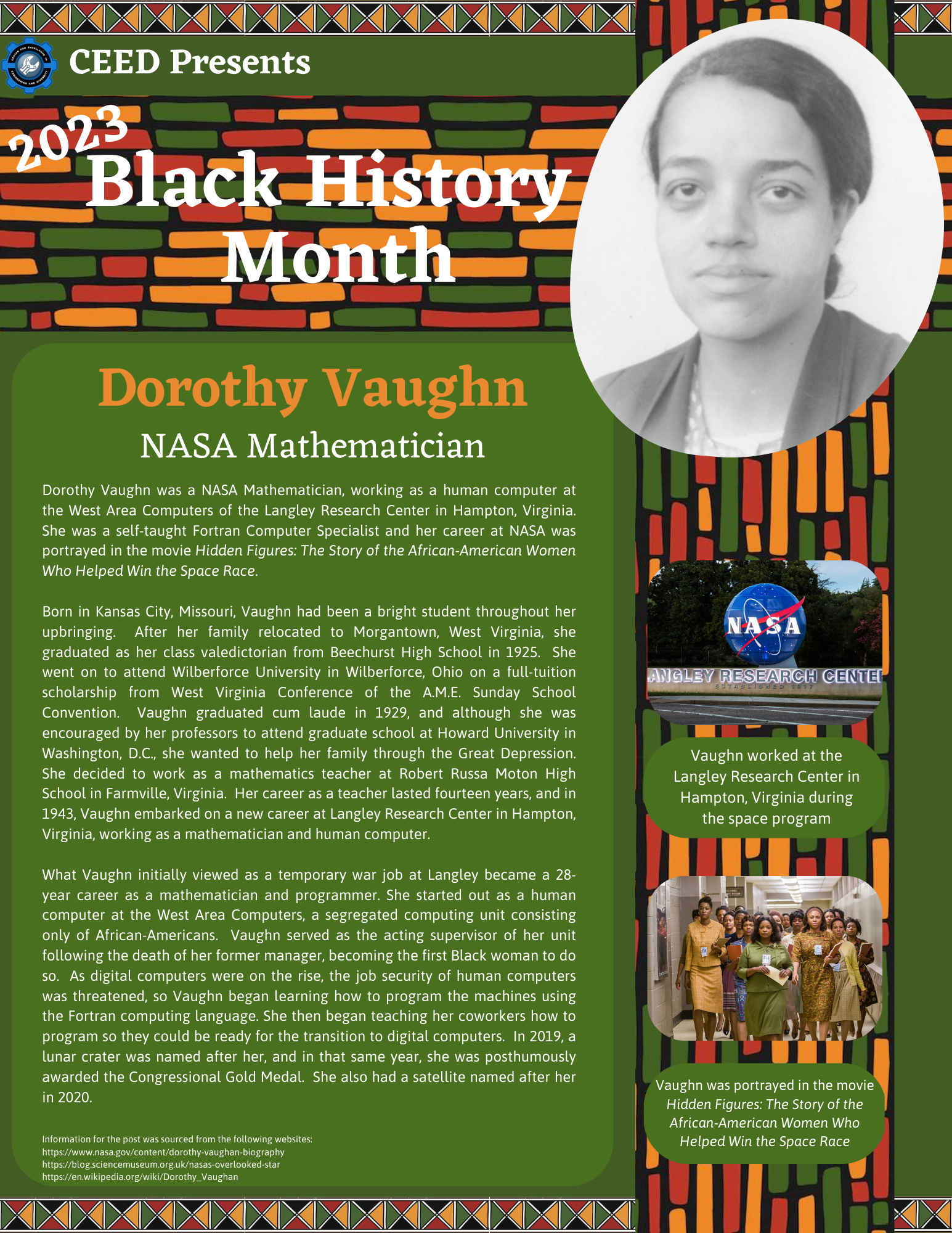
Black History Month Flyer about Dorothy Vaughn. Contains the following information: Dorothy Vaughn was a NASA Mathematician, working as a human computer at the West Area Computers of the Langley Research Center in Hampton, Virginia. She was a self-taught Fortran Computer Specialist and her career at NASA was portrayed in the movie Hidden Figures: The Story of the African-American Women Who Helped Win the Space Race. Born in Kansas City, Missouri, Vaughn had been a bright student throughout her upbringing. After her family relocated to Morgantown, West Virginia, she graduated as her class valedictorian from Beechurst High School in 1925. She went on to attend Wilberforce University in Wilberforce, Ohio on a full-tuition scholarship from West Virginia Conference of the A.M.E. Sunday School Convention. Vaughn graduated cum laude in 1929, and although she was encouraged by her professors to attend graduate school at Howard University in Washington, D.C., she wanted to help her family through the Great Depression. She decided to work as a mathematics teacher at Robert Russa Moton High School in Farmville, Virginia. Her career as a teacher lasted fourteen years, and in 1943, Vaughn embarked on a new career at Langley Research Center in Hampton, Virginia, working as a mathematician and human computer. What Vaughn initially viewed as a temporary war job at Langley became a 28-year career as a mathematician and programmer. She started out as a human computer at the West Area Computers, a segregated computing unit consisting only of African-Americans. Vaughn served as the acting supervisor of her unit following the death of her former manager, becoming the first Black woman to do so. As digital computers were on the rise, the job security of human computers was threatened, so Vaughn began learning how to program the machines using the Fortran computing language. She then began teaching her coworkers how to program so they could be ready for the transition to digital computers. In 2019, a lunar crater was named after her, and in that same year, she was posthumously awarded the Congressional Gold Medal. She also had a satellite named after her in 2020. Information for the post was sourced from the following websites: https://www.nasa.gov/content/dorothy-vaughan-biography https://blog.sciencemuseum.org.uk/nasas-overlooked-star https://en.wikipedia.org/wiki/Dorothy_Vaughan
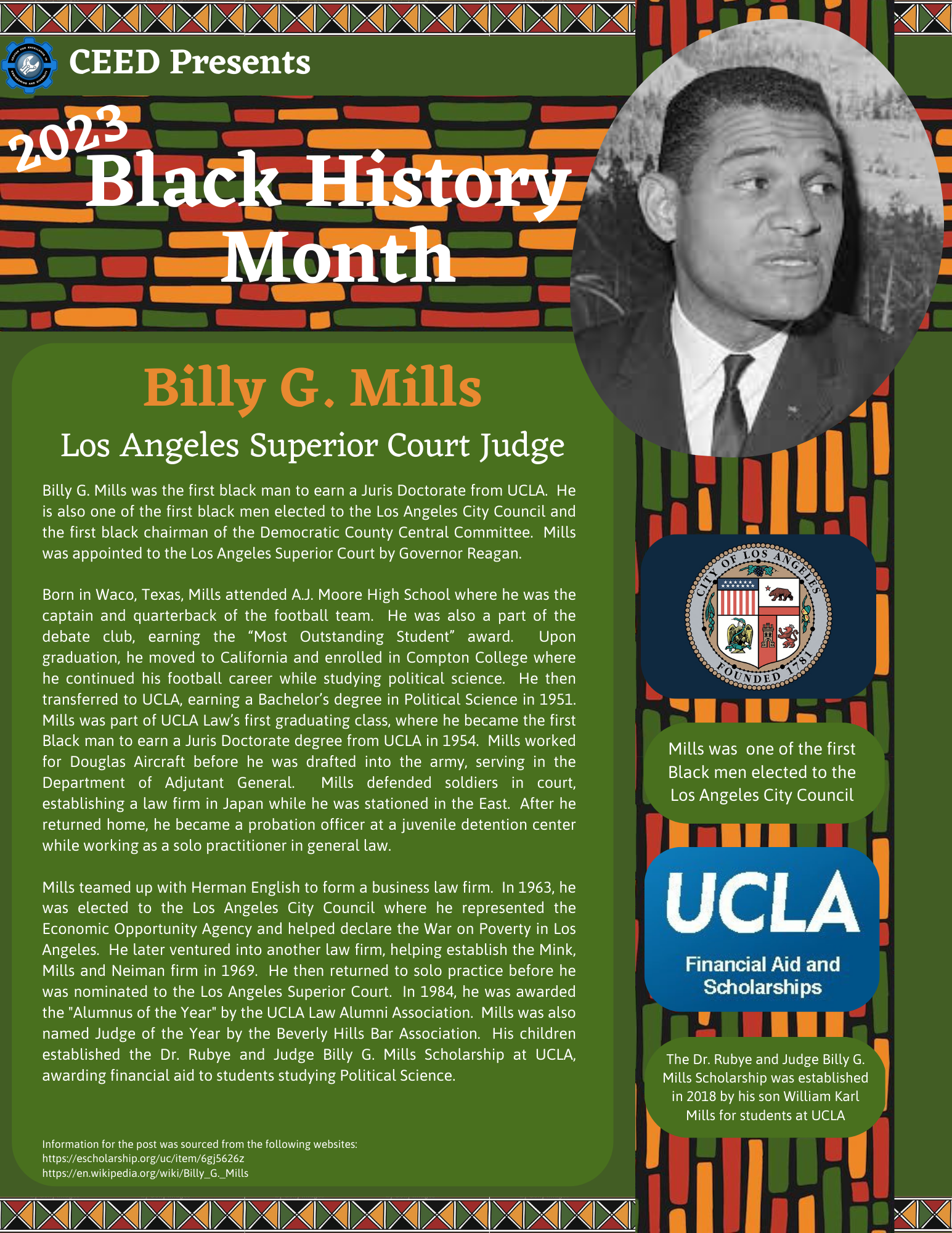
Black History Month Flyer about Billy G Mills. Contains the following information: Billy G. Mills was the first black man to earn a Juris Doctorate from UCLA. He is also one of the first black men elected to the Los Angeles City Council and the first black chairman of the Democratic County Central Committee. Mills was appointed to the Los Angeles Superior Court by Governor Reagan. Born in Waco, Texas, Mills attended A.J. Moore High School where he was the captain and quarterback of the football team. He was also a part of the debate club, earning the “Most Outstanding Student” award. Upon graduation, he moved to California and enrolled in Compton College where he continued his football career while studying political science. He then transferred to UCLA, earning a Bachelor’s degree in Political Science in 1951. Mills was part of UCLA Law’s first graduating class, where he became the first Black man to earn a Juris Doctorate degree from UCLA in 1954. Mills worked for Douglas Aircraft before he was drafted into the army, serving in the Department of Adjutant General. Mills defended soldiers in court, establishing a law firm in Japan while he was stationed in the East. After he returned home, he became a probation officer at a juvenile detention center while working as a solo practitioner in general law. Mills teamed up with Herman English to form a business law firm. In 1963, he was elected to the Los Angeles City Council where he represented the Economic Opportunity Agency and helped declare the War on Poverty in Los Angeles. He later ventured into another law firm, helping establish the Mink, Mills and Neiman firm in 1969. He then returned to solo practice before he was nominated to the Los Angeles Superior Court. In 1984, he was awarded the "Alumnus of the Year" by the UCLA Law Alumni Association. Mills was also named Judge of the Year by the Beverly Hills Bar Association. His children established the Dr. Rubye and Judge Billy G. Mills Scholarship at UCLA, awarding financial aid to students studying Political Science. Information for the post was sourced from the following websites: https://escholarship.org/uc/item/6gj5626z https://en.wikipedia.org/wiki/Billy_G._Mills
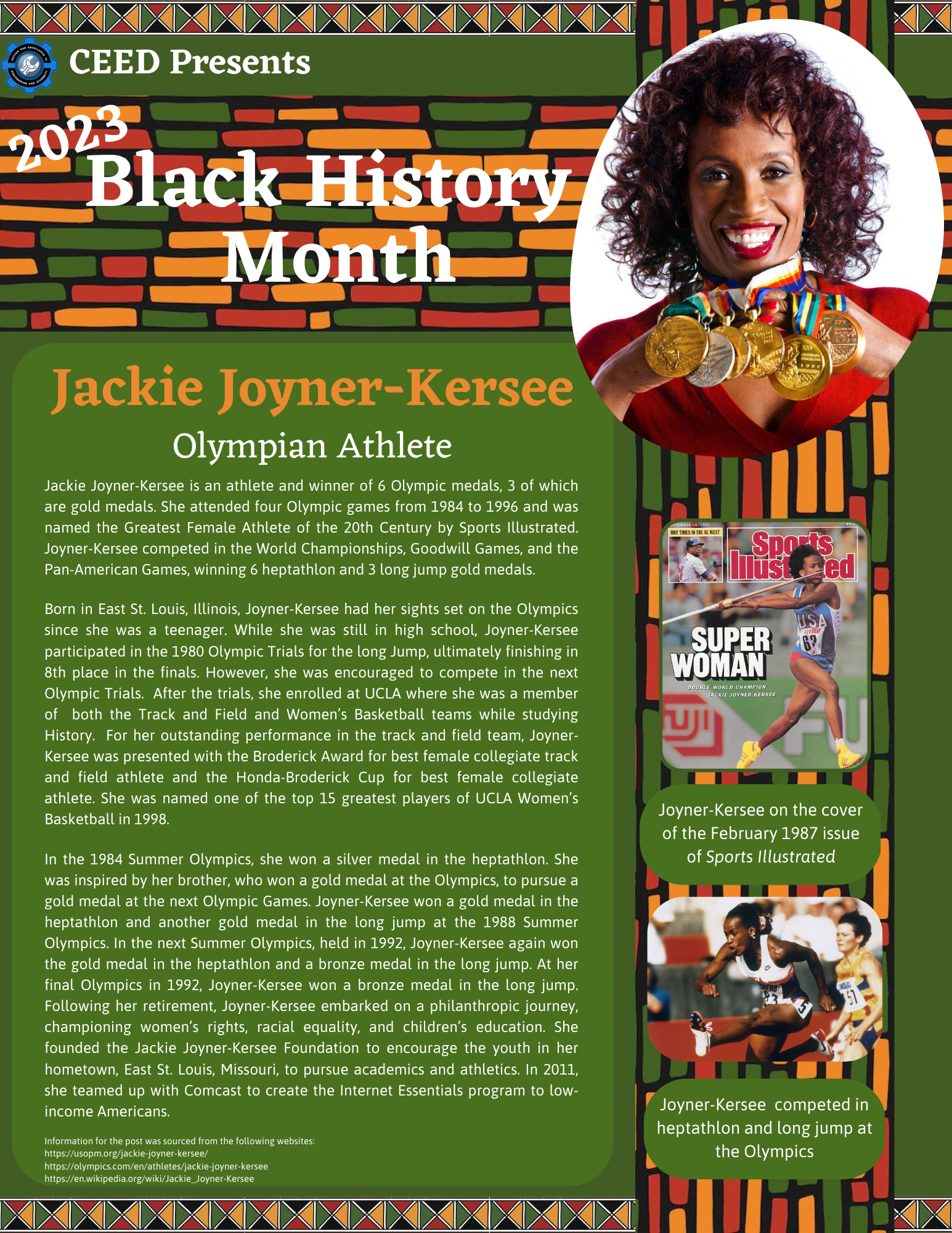
BHM Flyer for Jackie Joyner Kersee. Contains the following information: Jackie Joyner-Kersee is an athlete and winner of 6 Olympic medals, 3 of which are gold medals. She attended four Olympic games from 1984 to 1996 and was named the Greatest Female Athlete of the 20th Century by Sports Illustrated. Joyner-Kersee competed in the World Championships, Goodwill Games, and the Pan-American Games, winning 6 heptathlon and 3 long jump gold medals. Born in East St. Louis, Illinois, Joyner-Kersee had her sights set on the Olympics since she was a teenager. While she was still in high school, Joyner-Kersee participated in the 1980 Olympic Trials for the long Jump, ultimately finishing in 8th place in the finals. However, she was encouraged to compete in the next Olympic Trials. After the trials, she enrolled at UCLA where she was a member of both the Track and Field and Women’s Basketball teams while studying History. For her outstanding performance in the track and field team, Joyner-Kersee was presented with the Broderick Award for best female collegiate track and field athlete and the Honda-Broderick Cup for best female collegiate athlete. She was named one of the top 15 greatest players of UCLA Women’s Basketball in 1998. In the 1984 Summer Olympics, she won a silver medal in the heptathlon. She was inspired by her brother, who won a gold medal at the Olympics, to pursue a gold medal at the next Olympic Games. Joyner-Kersee won a gold medal in the heptathlon and another gold medal in the long jump at the 1988 Summer Olympics. In the next Summer Olympics, held in 1992, Joyner-Kersee again won the gold medal in the heptathlon and a bronze medal in the long jump. At her final Olympics in 1992, Joyner-Kersee won a bronze medal in the long jump. Following her retirement, Joyner-Kersee embarked on a philanthropic journey, championing women’s rights, racial equality, and children’s education. She founded the Jackie Joyner-Kersee Foundation to encourage the youth in her hometown, East St. Louis, Missouri, to pursue academics and athletics. In 2011, she teamed up with Comcast to create the Internet Essentials program to low-income Americans. Information for the post was sourced from the following websites: https://usopm.org/jackie-joyner-kersee/ https://olympics.com/en/athletes/jackie-joyner-kersee https://en.wikipedia.org/wiki/Jackie_Joyner-Kersee
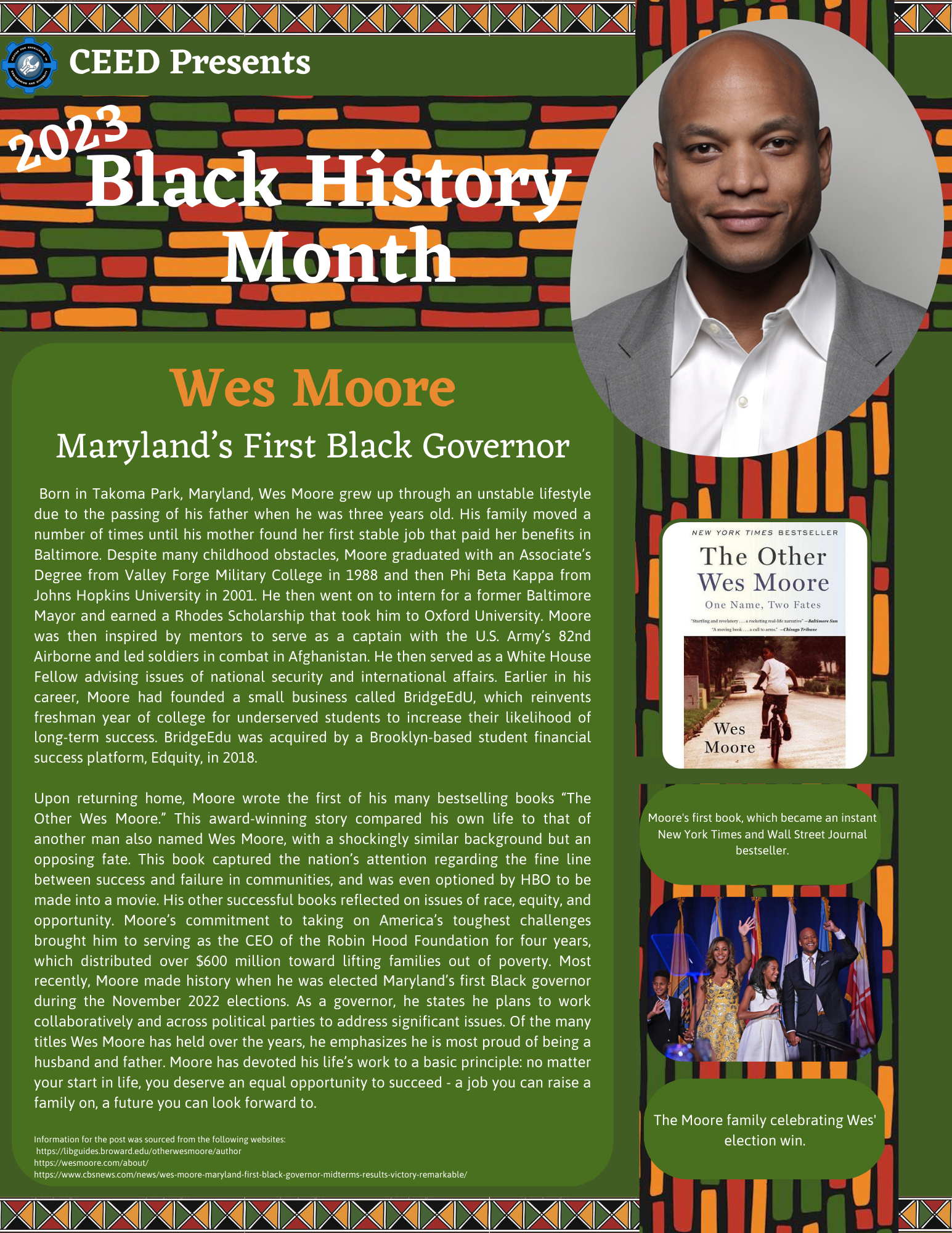
BHM Flyer for Wes Moore. Contains the following information: Born in Takoma Park, Maryland, Wes Moore grew up through an unstable lifestyle due to the passing of his father when he was three years old. His family moved a number of times until his mother found her first stable job that paid her benefits in Baltimore. Despite many childhood obstacles, Moore graduated with an Associate’s Degree from Valley Forge Military College in 1988 and then Phi Beta Kappa from Johns Hopkins University in 2001. He then went on to intern for a former Baltimore Mayor and earned a Rhodes Scholarship that took him to Oxford University. Moore was then inspired by mentors to serve as a captain with the U.S. Army’s 82nd Airborne and led soldiers in combat in Afghanistan. He then served as a White House Fellow advising issues of national security and international affairs. Earlier in his career, Moore had founded a small business called BridgeEdU, which reinvents freshman year of college for underserved students to increase their likelihood of long-term success. BridgeEdu was acquired by a Brooklyn-based student financial success platform, Edquity, in 2018. Upon returning home, Moore wrote the first of his many bestselling books “The Other Wes Moore.” This award-winning story compared his own life to that of another man also named Wes Moore, with a shockingly similar background but an opposing fate. This book captured the nation’s attention regarding the fine line between success and failure in communities, and was even optioned by HBO to be made into a movie. His other successful books reflected on issues of race, equity, and opportunity. Moore’s commitment to taking on America’s toughest challenges brought him to serving as the CEO of the Robin Hood Foundation for four years, which distributed over $600 million toward lifting families out of poverty. Most recently, Moore made history when he was elected Maryland’s first Black governor during the November 2022 elections. As a governor, he states he plans to work collaboratively and across political parties to address significant issues. Of the many titles Wes Moore has held over the years, he emphasizes he is most proud of being a husband and father. Moore has devoted his life’s work to a basic principle: no matter your start in life, you deserve an equal opportunity to succeed - a job you can raise a family on, a future you can look forward to. Information for the post was sourced from the following websites: https://libguides.broward.edu/otherwesmoore/author https://wesmoore.com/about/ https://www.cbsnews.com/news/wes-moore-maryland-first-black-governor-midterms-results-victory-remarkable/
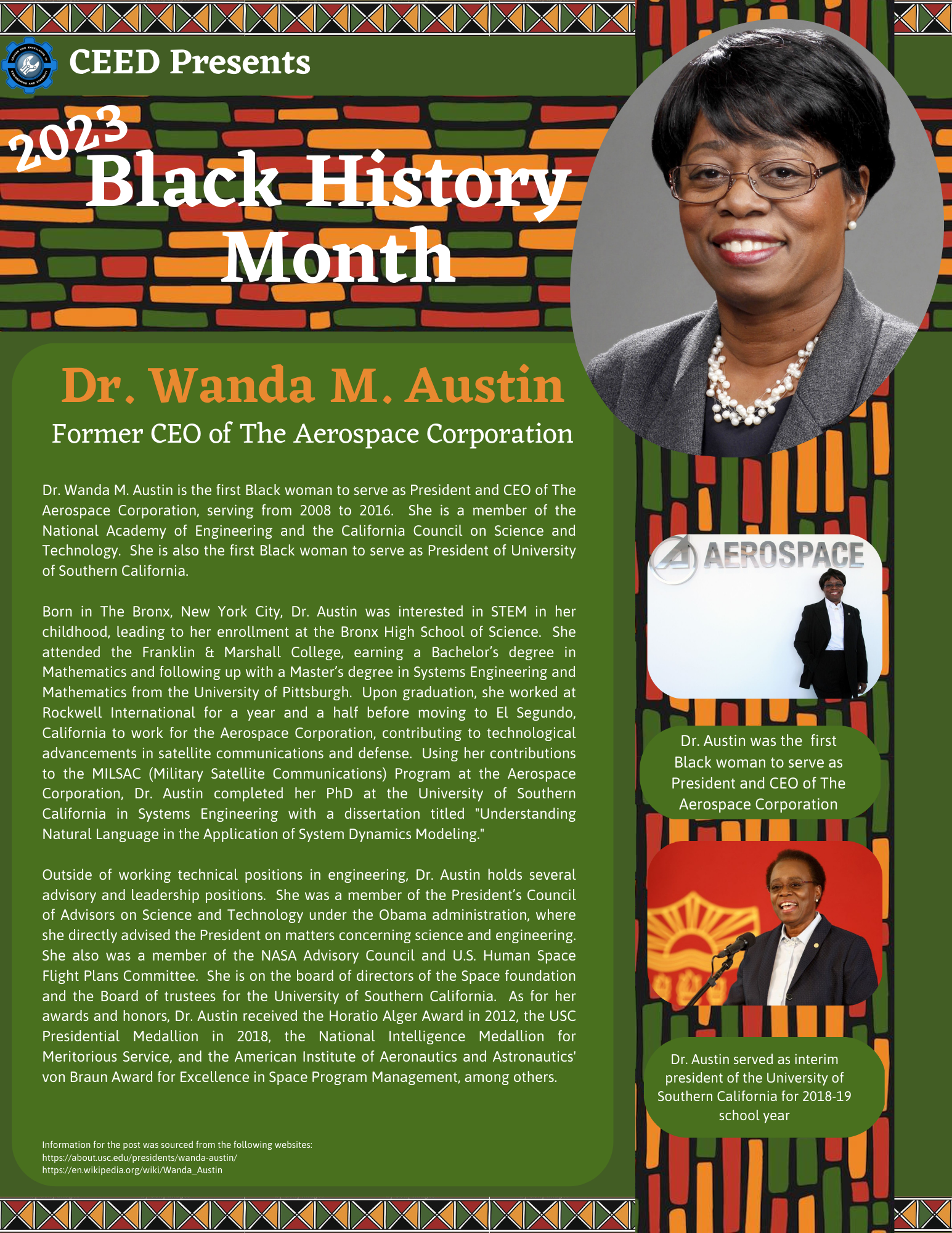
BHM Flyer for Dr. Wanda M Austin. Contains the following information: Dr. Wanda M. Austin is the first Black woman to serve as President and CEO of The Aerospace Corporation, serving from 2008 to 2016. She is a member of the National Academy of Engineering and the California Council on Science and Technology. She is also the first Black woman to serve as President of University of Southern California. Born in The Bronx, New York City, Dr. Austin was interested in STEM in her childhood, leading to her enrollment at the Bronx High School of Science. She attended the Franklin & Marshall College, earning a Bachelor’s degree in Mathematics and following up with a Master’s degree in Systems Engineering and Mathematics from the University of Pittsburgh. Upon graduation, she worked at Rockwell International for a year and a half before moving to El Segundo, California to work for the Aerospace Corporation, contributing to technological advancements in satellite communications and defense. Using her contributions to the MILSAC (Military Satellite Communications) Program at the Aerospace Corporation, Dr. Austin completed her PhD at the University of Southern California in Systems Engineering with a dissertation titled "Understanding Natural Language in the Application of System Dynamics Modeling." Outside of working technical positions in engineering, Dr. Austin holds several advisory and leadership positions. She was a member of the President’s Council of Advisors on Science and Technology under the Obama administration, where she directly advised the President on matters concerning science and engineering. She also was a member of the NASA Advisory Council and U.S. Human Space Flight Plans Committee. She is on the board of directors of the Space foundation and the Board of trustees for the University of Southern California. As for her awards and honors, Dr. Austin received the Horatio Alger Award in 2012, the USC Presidential Medallion in 2018, the National Intelligence Medallion for Meritorious Service, and the American Institute of Aeronautics and Astronautics' von Braun Award for Excellence in Space Program Management, among others. Information for the post was sourced from the following websites: https://about.usc.edu/presidents/wanda-austin/ https://en.wikipedia.org/wiki/Wanda_Austin
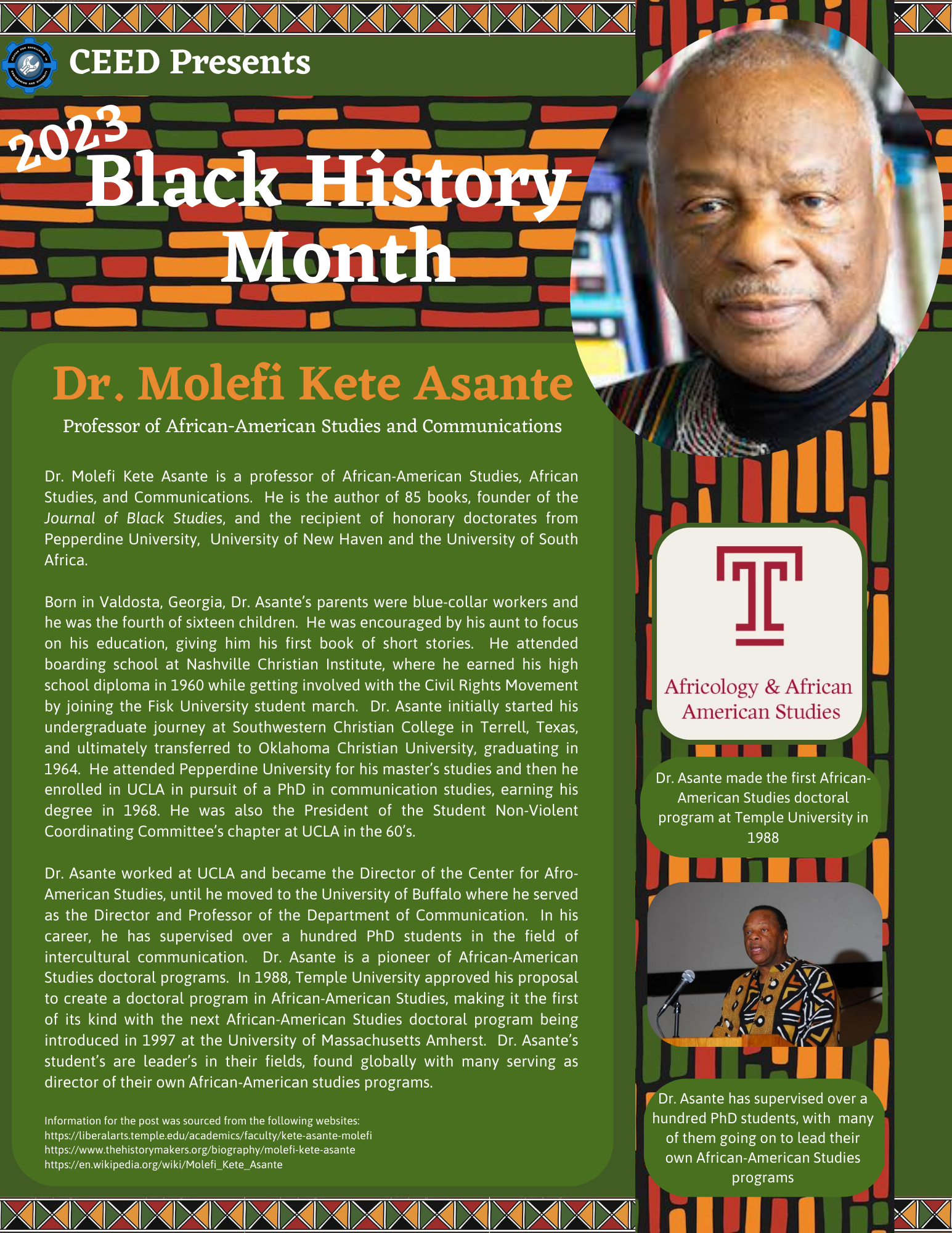
BHM Flyer for Dr. Molefi Kete Asante. Contains the following information: Dr. Molefi Kete Asante is a professor of African-American Studies, African Studies, and Communications. He is the author of 85 books, founder of the Journal of Black Studies, and the recipient of honorary doctorates from Pepperdine University, University of New Haven and the University of South Africa. Born in Valdosta, Georgia, Dr. Asante’s parents were blue-collar workers and he was the fourth of sixteen children. He was encouraged by his aunt to focus on his education, giving him his first book of short stories. He attended boarding school at Nashville Christian Institute, where he earned his high school diploma in 1960 while getting involved with the Civil Rights Movement by joining the Fisk University student march. Dr. Asante initially started his undergraduate journey at Southwestern Christian College in Terrell, Texas, and ultimately transferred to Oklahoma Christian University, graduating in 1964. He attended Pepperdine University for his master’s studies and then he enrolled in UCLA in pursuit of a PhD in communication studies, earning his degree in 1968. He was also the President of the Student Non-Violent Coordinating Committee’s chapter at UCLA in the 60’s. Dr. Asante worked at UCLA and became the Director of the Center for Afro-American Studies, until he moved to the University of Buffalo where he served as the Director and Professor of the Department of Communication. In his career, he has supervised over a hundred PhD students in the field of intercultural communication. Dr. Asante is a pioneer of African-American Studies doctoral programs. In 1988, Temple University approved his proposal to create a doctoral program in African-American Studies, making it the first of its kind with the next African-American Studies doctoral program being introduced in 1997 at the University of Massachusetts Amherst. Dr. Asante’s student’s are leader’s in their fields, found globally with many serving as director of their own African-American studies programs. Information for the post was sourced from the following websites: https://liberalarts.temple.edu/academics/faculty/kete-asante-molefi https://www.thehistorymakers.org/biography/molefi-kete-asante https://en.wikipedia.org/wiki/Molefi_Kete_Asante
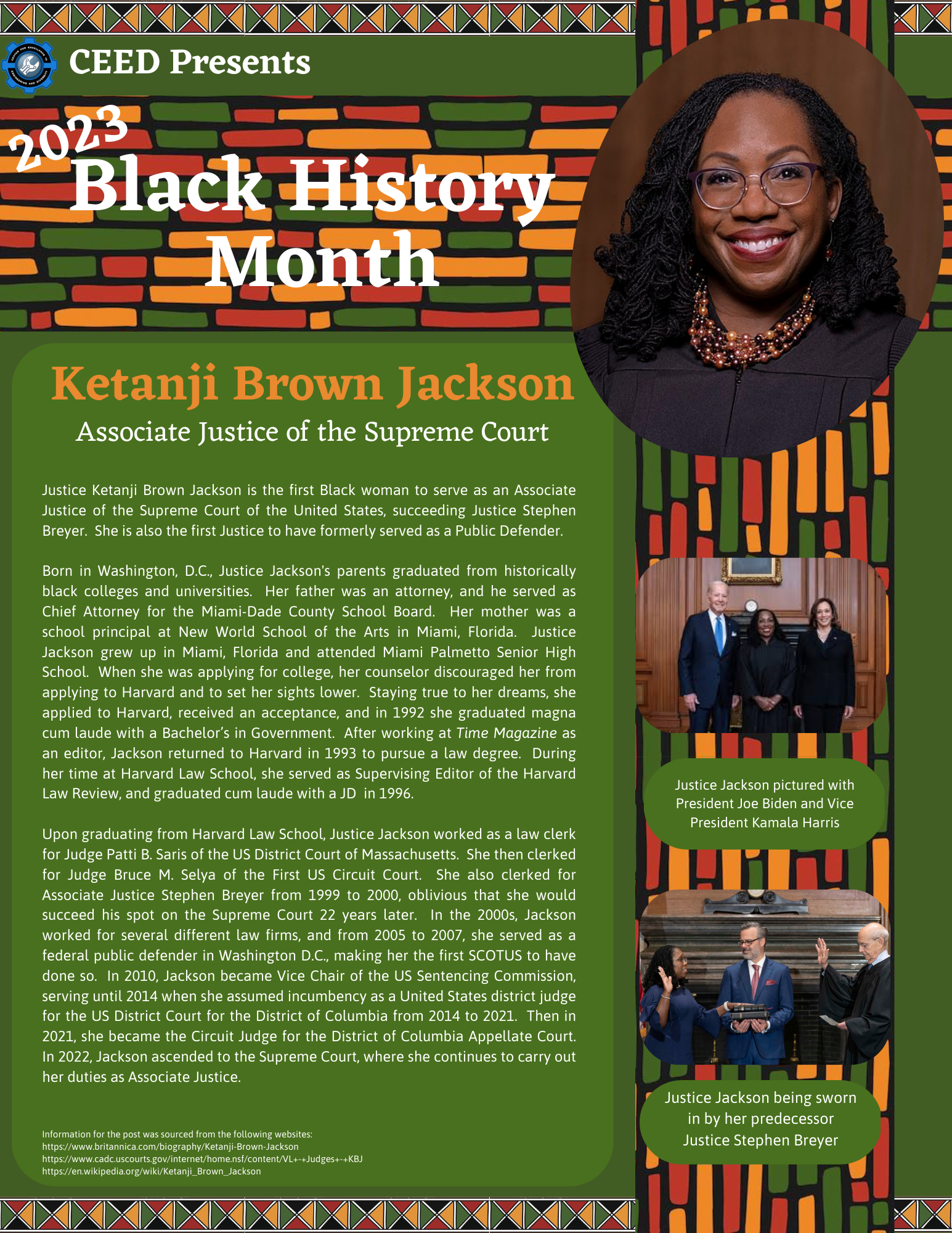
BHM Flyer for Ketanji Brown-Jackson. Contains the following information: Justice Ketanji Brown Jackson is the first Black woman to serve as an Associate Justice of the Supreme Court of the United States, succeeding Justice Stephen Breyer. She is also the first Justice to have formerly served as a Public Defender. Born in Washington, D.C., Justice Jackson's parents graduated from historically black colleges and universities. Her father was an attorney, and he served as Chief Attorney for the Miami-Dade County School Board. Her mother was a school principal at New World School of the Arts in Miami, Florida. Justice Jackson grew up in Miami, Florida and attended Miami Palmetto Senior High School. When she was applying for college, her counselor discouraged her from applying to Harvard and to set her sights lower. Staying true to her dreams, she applied to Harvard, received an acceptance, and in 1992 she graduated magna cum laude with a Bachelor’s in Government. After working at Time Magazine as an editor, Jackson returned to Harvard in 1993 to pursue a law degree. During her time at Harvard Law School, she served as Supervising Editor of the Harvard Law Review, and graduated cum laude with a JD in 1996. Upon graduating from Harvard Law School, Justice Jackson worked as a law clerk for Judge Patti B. Saris of the US District Court of Massachusetts. She then clerked for Judge Bruce M. Selya of the First US Circuit Court. She also clerked for Associate Justice Stephen Breyer from 1999 to 2000, oblivious that she would succeed his spot on the Supreme Court 22 years later. In the 2000s, Jackson worked for several different law firms, and from 2005 to 2007, she served as a federal public defender in Washington D.C., making her the first SCOTUS to have done so. In 2010, Jackson became Vice Chair of the US Sentencing Commission, serving until 2014 when she assumed incumbency as a United States district judge for the US District Court for the District of Columbia from 2014 to 2021. Then in 2021, she became the Circuit Judge for the District of Columbia Appellate Court. In 2022, Jackson ascended to the Supreme Court, where she continues to carry out her duties as Associate Justice. Information for the post was sourced from the following websites: https://www.britannica.com/biography/Ketanji-Brown-Jackson https://www.cadc.uscourts.gov/internet/home.nsf/content/VL+-+Judges+-+KBJ https://en.wikipedia.org/wiki/Ketanji_Brown_Jackson
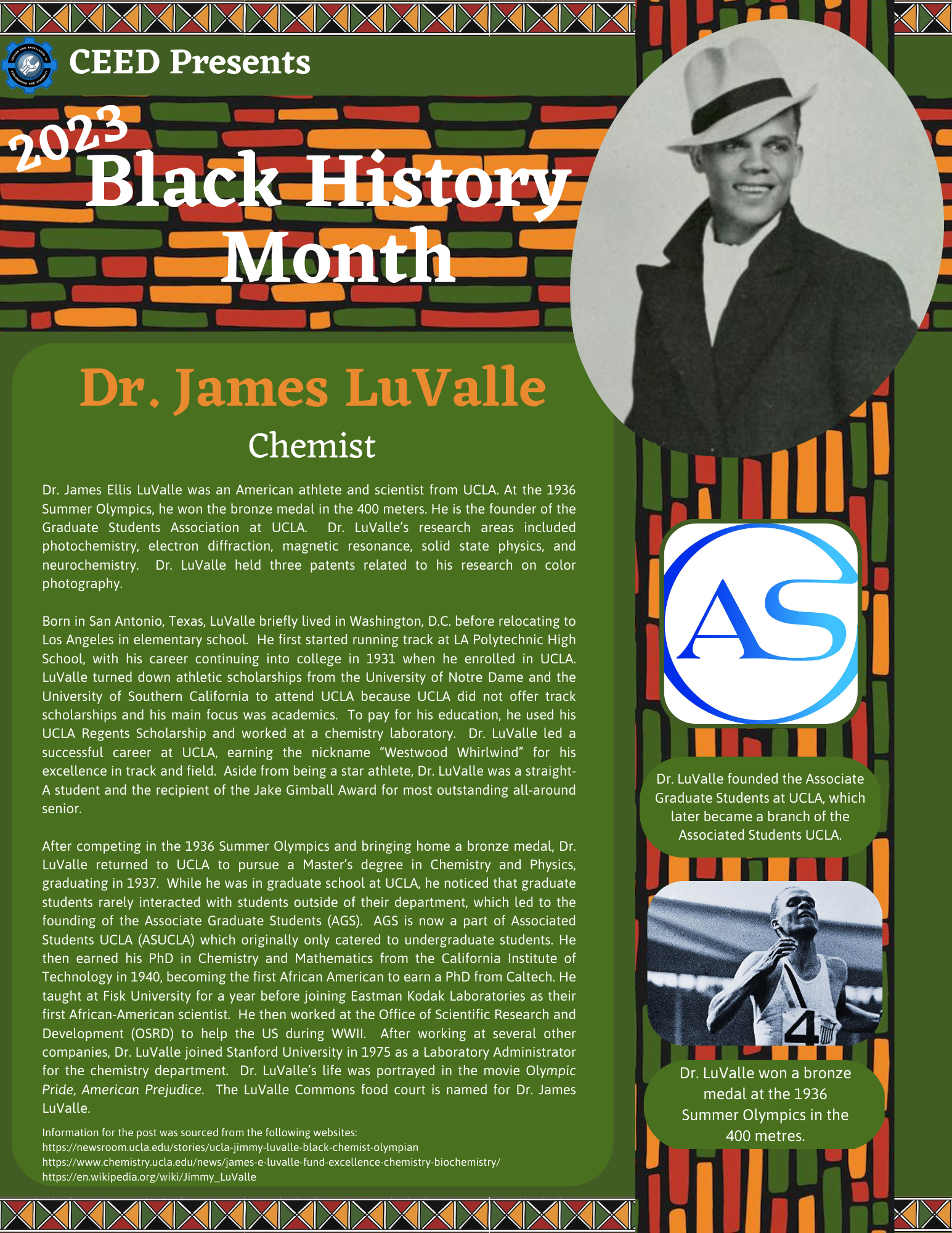
BHM Flyer for Dr. James LuValle. Contains the following information: Dr. James Ellis LuValle was an American athlete and scientist from UCLA. At the 1936 Summer Olympics, he won the bronze medal in the 400 meters. He is the founder of the Graduate Students Association at UCLA. Dr. LuValle’s research areas included photochemistry, electron diffraction, magnetic resonance, solid state physics, and neurochemistry. Dr. LuValle held three patents related to his research on color photography. Born in San Antonio, Texas, LuValle briefly lived in Washington, D.C. before relocating to Los Angeles in elementary school. He first started running track at LA Polytechnic High School, with his career continuing into college in 1931 when he enrolled in UCLA. LuValle turned down athletic scholarships from the University of Notre Dame and the University of Southern California to attend UCLA because UCLA did not offer track scholarships and his main focus was academics. To pay for his education, he used his UCLA Regents Scholarship and worked at a chemistry laboratory. Dr. LuValle led a successful career at UCLA, earning the nickname “Westwood Whirlwind” for his excellence in track and field. Aside from being a star athlete, Dr. LuValle was a straight-A student and the recipient of the Jake Gimball Award for most outstanding all-around senior. After competing in the 1936 Summer Olympics and bringing home a bronze medal, Dr. LuValle returned to UCLA to pursue a Master’s degree in Chemistry and Physics, graduating in 1937. While he was in graduate school at UCLA, he noticed that graduate students rarely interacted with students outside of their department, which led to the founding of the Associate Graduate Students (AGS). AGS is now a part of Associated Students UCLA (ASUCLA) which originally only catered to undergraduate students. He then earned his PhD in Chemistry and Mathematics from the California Institute of Technology in 1940, becoming the first African American to earn a PhD from Caltech. He taught at Fisk University for a year before joining Eastman Kodak Laboratories as their first African-American scientist. He then worked at the Office of Scientific Research and Development (OSRD) to help the US during WWII. After working at several other companies, Dr. LuValle joined Stanford University in 1975 as a Laboratory Administrator for the chemistry department. Dr. LuValle’s life was portrayed in the movie Olympic Pride, American Prejudice. The LuValle Commons food court is named for Dr. James LuValle. Information for the post was sourced from the following websites: https://newsroom.ucla.edu/stories/ucla-jimmy-luvalle-black-chemist-olympian https://www.chemistry.ucla.edu/news/james-e-luvalle-fund-excellence-chemistry-biochemistry/ https://en.wikipedia.org/wiki/Jimmy_LuValle
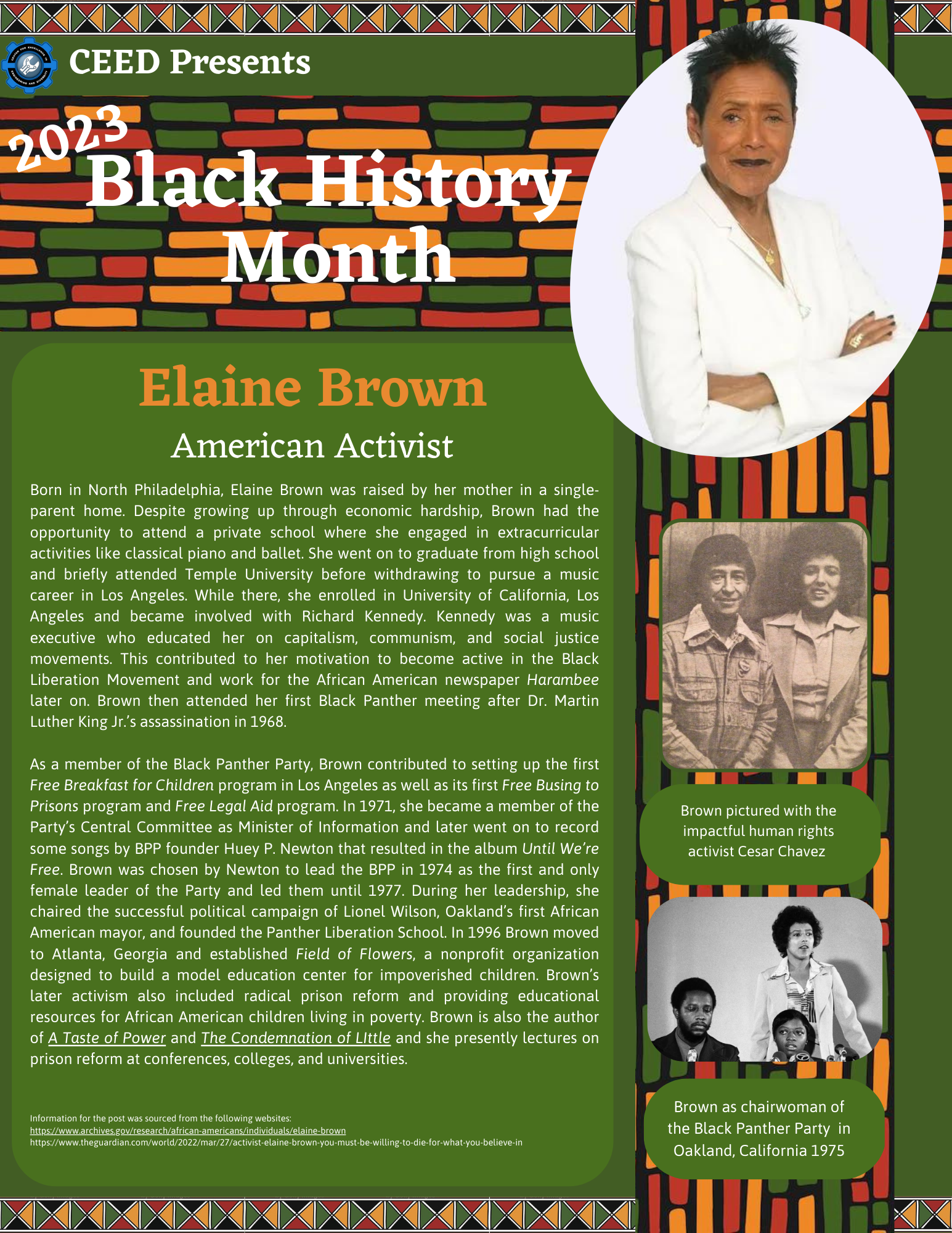
Born in North Philadelphia, Elaine Brown was raised by her mother in a single-parent home. Despite growing up through economic hardship, Brown had the opportunity to attend a private school where she engaged in extracurricular activities like classical piano and ballet. She went on to graduate from high school and briefly attended Temple University before withdrawing to pursue a music career in Los Angeles. While there, she enrolled in University of California, Los Angeles and became involved with Richard Kennedy. Kennedy was a music executive who educated her on capitalism, communism, and social justice movements. This contributed to her motivation to become active in the Black Liberation Movement and work for the African American newspaper Harambee later on. Brown then attended her first Black Panther meeting after Dr. Martin Luther King Jr.’s assassination in 1968. As a member of the Black Panther Party, Brown contributed to setting up the first Free Breakfast for Children program in Los Angeles as well as its first Free Busing to Prisons program and Free Legal Aid program. In 1971, she became a member of the Party’s Central Committee as Minister of Information and later went on to record some songs by BPP founder Huey P. Newton that resulted in the album Until We’re Free. Brown was chosen by Newton to lead the BPP in 1974 as the first and only female leader of the Party and led them until 1977. During her leadership, she chaired the successful political campaign of Lionel Wilson, Oakland’s first African American mayor, and founded the Panther Liberation School. In 1996 Brown moved to Atlanta, Georgia and established Field of Flowers, a nonprofit organization designed to build a model education center for impoverished children. Brown’s later activism also included radical prison reform and providing educational resources for African American children living in poverty. Brown is also the author of A Taste of Power and The Condemnation of LIttle and she presently lectures on prison reform at conferences, colleges, and universities. Information for the post was sourced from the following websites: https://www.archives.gov/research/african-americans/individuals/elaine-brown https://www.theguardian.com/world/2022/mar/27/activist-elaine-brown-you-must-be-willing-to-die-for-what-you-believe-in
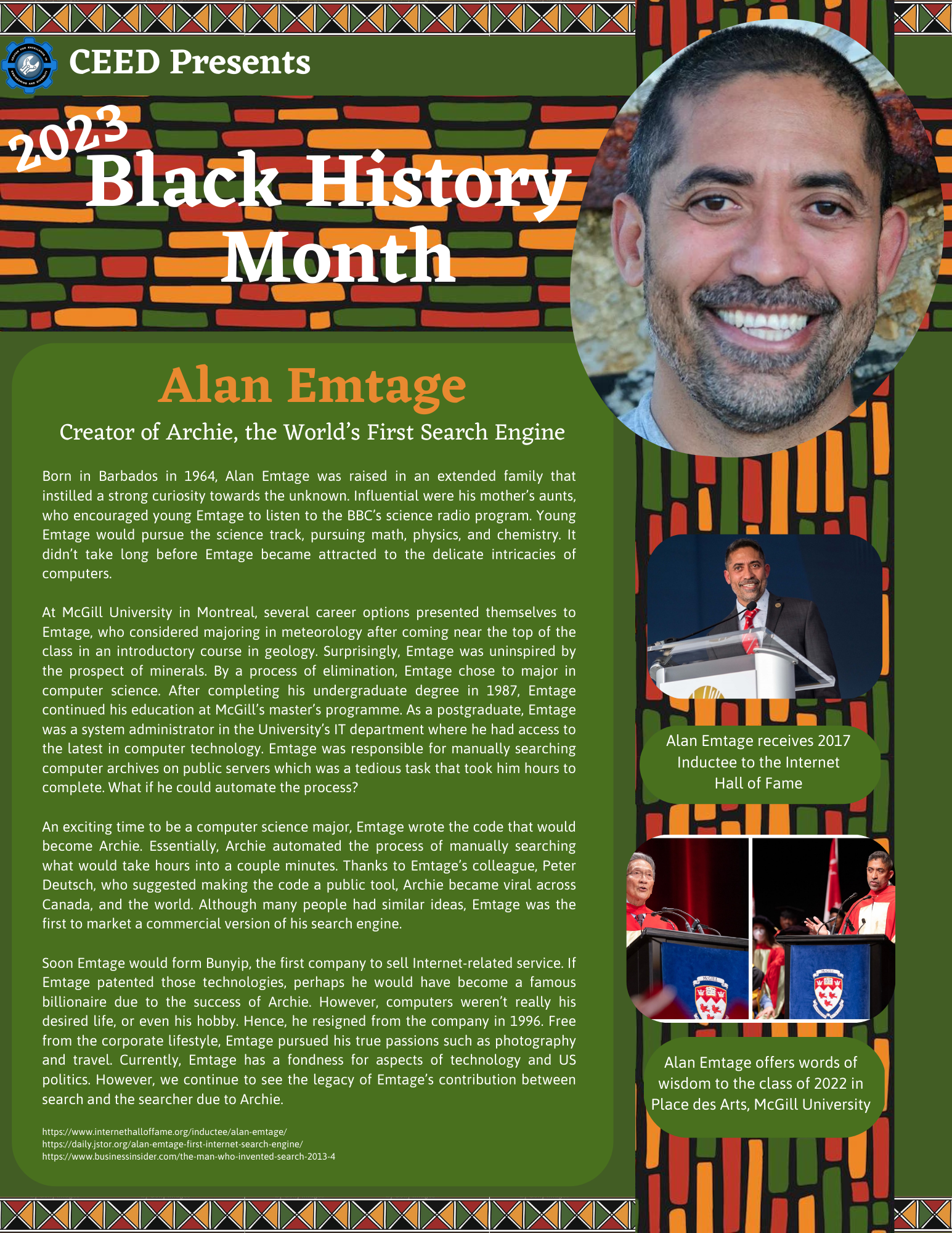
BHM Flyer for Alan Emtage. Contains the following information: Born in Barbados in 1964, Alan Emtage was raised in an extended family that instilled a strong curiosity towards the unknown. Influential were his mother’s aunts, who encouraged young Emtage to listen to the BBC’s science radio program. Young Emtage would pursue the science track, pursuing math, physics, and chemistry. It didn’t take long before Emtage became attracted to the delicate intricacies of computers. At McGill University in Montreal, several career options presented themselves to Emtage, who considered majoring in meteorology after coming near the top of the class in an introductory course in geology. Surprisingly, Emtage was uninspired by the prospect of minerals. By a process of elimination, Emtage chose to major in computer science. After completing his undergraduate degree in 1987, Emtage continued his education at McGill’s master’s programme. As a postgraduate, Emtage was a system administrator in the University’s IT department where he had access to the latest in computer technology. Emtage was responsible for manually searching computer archives on public servers which was a tedious task that took him hours to complete. What if he could automate the process? An exciting time to be a computer science major, Emtage wrote the code that would become Archie. Essentially, Archie automated the process of manually searching what would take hours into a couple minutes. Thanks to Emtage’s colleague, Peter Deutsch, who suggested making the code a public tool, Archie became viral across Canada, and the world. Although many people had similar ideas, Emtage was the first to market a commercial version of his search engine. Soon Emtage would form Bunyip, the first company to sell Internet-related service. If Emtage patented those technologies, perhaps he would have become a famous billionaire due to the success of Archie. However, computers weren’t really his desired life, or even his hobby. Hence, he resigned from the company in 1996. Free from the corporate lifestyle, Emtage pursued his true passions such as photography and travel. Currently, Emtage has a fondness for aspects of technology and US politics. However, we continue to see the legacy of Emtage’s contribution between search and the searcher due to Archie. https://www.internethalloffame.org/inductee/alan-emtage/ https://daily.jstor.org/alan-emtage-first-internet-search-engine/ https://www.businessinsider.com/the-man-who-invented-search-2013-4
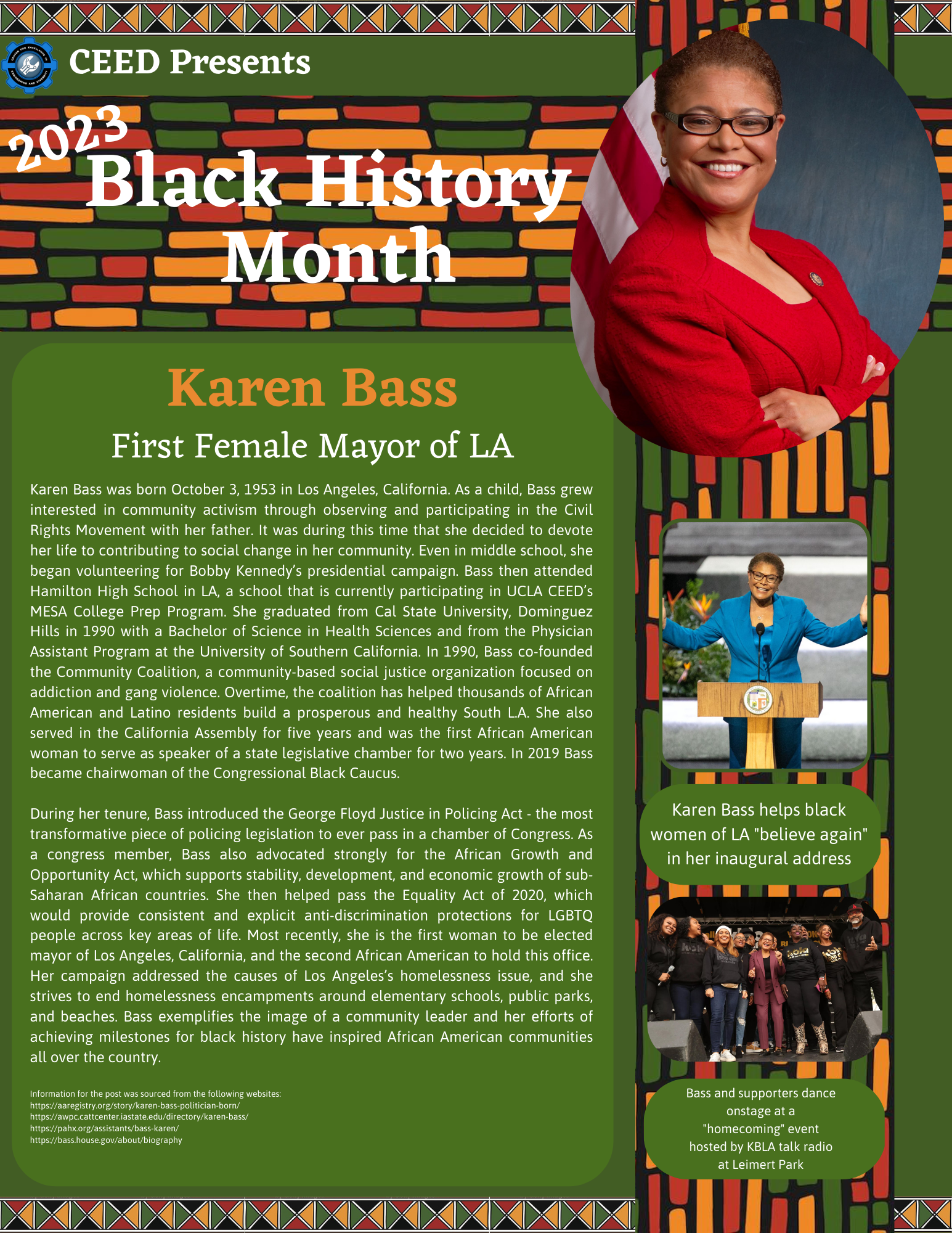
BHM Flyer for Karen Bass. Contains the following information: Karen Bass was born October 3, 1953 in Los Angeles, California. As a child, Bass grew interested in community activism through observing and participating in the Civil Rights Movement with her father. It was during this time that she decided to devote her life to contributing to social change in her community. Even in middle school, she began volunteering for Bobby Kennedy’s presidential campaign. Bass then attended Hamilton High School in LA, a school that is currently participating in UCLA CEED’s MESA College Prep Program. She graduated from Cal State University, Dominguez Hills in 1990 with a Bachelor of Science in Health Sciences and from the Physician Assistant Program at the University of Southern California. In 1990, Bass co-founded the Community Coalition, a community-based social justice organization focused on addiction and gang violence. Overtime, the coalition has helped thousands of African American and Latino residents build a prosperous and healthy South L.A. She also served in the California Assembly for five years and was the first African American woman to serve as speaker of a state legislative chamber for two years. In 2019 Bass became chairwoman of the Congressional Black Caucus. During her tenure, Bass introduced the George Floyd Justice in Policing Act - the most transformative piece of policing legislation to ever pass in a chamber of Congress. As a congress member, Bass also advocated strongly for the African Growth and Opportunity Act, which supports stability, development, and economic growth of sub-Saharan African countries. She then helped pass the Equality Act of 2020, which would provide consistent and explicit anti-discrimination protections for LGBTQ people across key areas of life. Most recently, she is the first woman to be elected mayor of Los Angeles, California, and the second African American to hold this office. Her campaign addressed the causes of Los Angeles’s homelessness issue, and she strives to end homelessness encampments around elementary schools, public parks, and beaches. Bass exemplifies the image of a community leader and her efforts of achieving milestones for black history have inspired African American communities all over the country. Information for the post was sourced from the following websites: https://aaregistry.org/story/karen-bass-politician-born/ https://awpc.cattcenter.iastate.edu/directory/karen-bass/ https://pahx.org/assistants/bass-karen/ https://bass.house.gov/about/biography
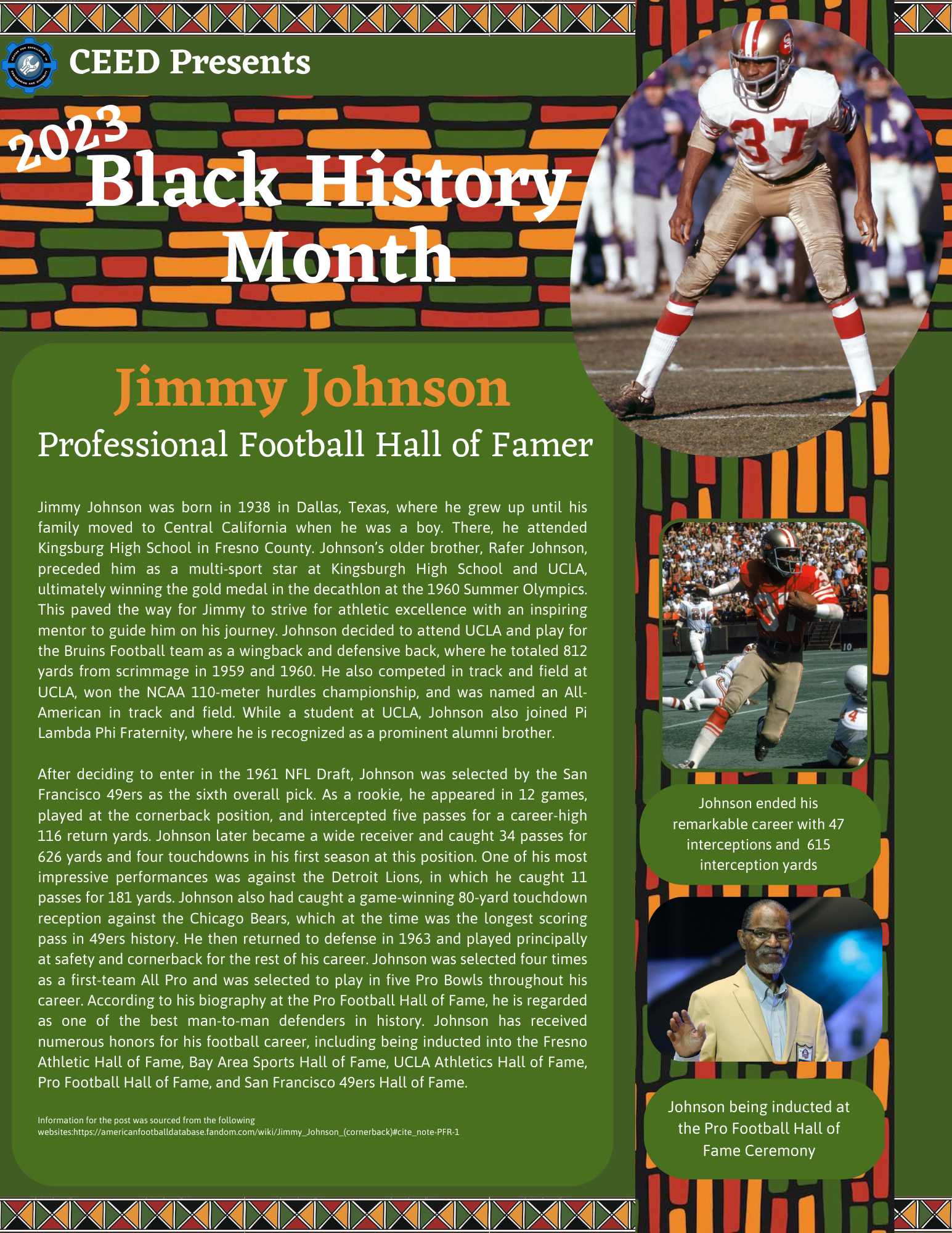
BHM Flyer for Jimmy Johnson. Contains the following information: Jimmy Johnson was born in 1938 in Dallas, Texas, where he grew up until his family moved to Central California when he was a boy. There, he attended Kingsburg High School in Fresno County. Johnson’s older brother, Rafer Johnson, preceded him as a multi-sport star at Kingsburgh High School and UCLA, ultimately winning the gold medal in the decathlon at the 1960 Summer Olympics. This paved the way for Jimmy to strive for athletic excellence with an inspiring mentor to guide him on his journey. Johnson decided to attend UCLA and play for the Bruins Football team as a wingback and defensive back, where he totaled 812 yards from scrimmage in 1959 and 1960. He also competed in track and field at UCLA, won the NCAA 110-meter hurdles championship, and was named an All-American in track and field. While a student at UCLA, Johnson also joined Pi Lambda Phi Fraternity, where he is recognized as a prominent alumni brother. After deciding to enter in the 1961 NFL Draft, Johnson was selected by the San Francisco 49ers as the sixth overall pick. As a rookie, he appeared in 12 games, played at the cornerback position, and intercepted five passes for a career-high 116 return yards. Johnson later became a wide receiver and caught 34 passes for 626 yards and four touchdowns in his first season at this position. One of his most impressive performances was against the Detroit Lions, in which he caught 11 passes for 181 yards. Johnson also had caught a game-winning 80-yard touchdown reception against the Chicago Bears, which at the time was the longest scoring pass in 49ers history. He then returned to defense in 1963 and played principally at safety and cornerback for the rest of his career. Johnson was selected four times as a first-team All Pro and was selected to play in five Pro Bowls throughout his career. According to his biography at the Pro Football Hall of Fame, he is regarded as one of the best man-to-man defenders in history. Johnson has received numerous honors for his football career, including being inducted into the Fresno Athletic Hall of Fame, Bay Area Sports Hall of Fame, UCLA Athletics Hall of Fame, Pro Football Hall of Fame, and San Francisco 49ers Hall of Fame. Information for the post was sourced from the following websites:https://americanfootballdatabase.fandom.com/wiki/Jimmy_Johnson_(cornerback)#cite_note-PFR-1
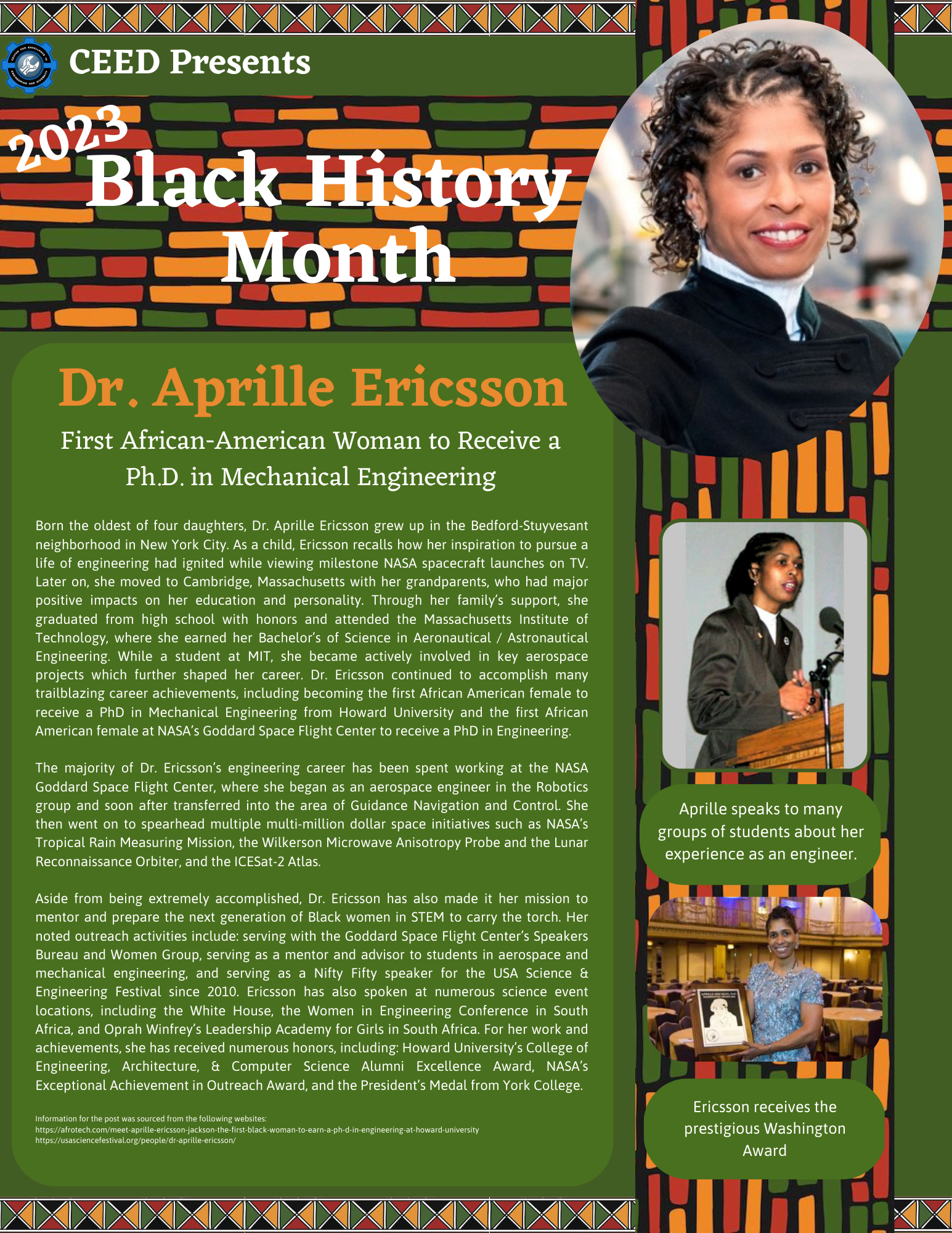
BHM Flyer for Dr. Aprille Ericsson. Contains the following information: Born the oldest of four daughters, Dr. Aprille Ericsson grew up in the Bedford-Stuyvesant neighborhood in New York City. As a child, Ericsson recalls how her inspiration to pursue a life of engineering had ignited while viewing milestone NASA spacecraft launches on TV. Later on, she moved to Cambridge, Massachusetts with her grandparents, who had major positive impacts on her education and personality. Through her family’s support, she graduated from high school with honors and attended the Massachusetts Institute of Technology, where she earned her Bachelor’s of Science in Aeronautical / Astronautical Engineering. While a student at MIT, she became actively involved in key aerospace projects which further shaped her career. Dr. Ericsson continued to accomplish many trailblazing career achievements, including becoming the first African American female to receive a PhD in Mechanical Engineering from Howard University and the first African American female at NASA’s Goddard Space Flight Center to receive a PhD in Engineering. The majority of Dr. Ericsson’s engineering career has been spent working at the NASA Goddard Space Flight Center, where she began as an aerospace engineer in the Robotics group and soon after transferred into the area of Guidance Navigation and Control. She then went on to spearhead multiple multi-million dollar space initiatives such as NASA’s Tropical Rain Measuring Mission, the Wilkerson Microwave Anisotropy Probe and the Lunar Reconnaissance Orbiter, and the ICESat-2 Atlas. Aside from being extremely accomplished, Dr. Ericsson has also made it her mission to mentor and prepare the next generation of Black women in STEM to carry the torch. Her noted outreach activities include: serving with the Goddard Space Flight Center’s Speakers Bureau and Women Group, serving as a mentor and advisor to students in aerospace and mechanical engineering, and serving as a Nifty Fifty speaker for the USA Science & Engineering Festival since 2010. Ericsson has also spoken at numerous science event locations, including the White House, the Women in Engineering Conference in South Africa, and Oprah Winfrey’s Leadership Academy for Girls in South Africa. For her work and achievements, she has received numerous honors, including: Howard University’s College of Engineering, Architecture, & Computer Science Alumni Excellence Award, NASA’s Exceptional Achievement in Outreach Award, and the President’s Medal from York College. Information for the post was sourced from the following websites: https://afrotech.com/meet-aprille-ericsson-jackson-the-first-black-woman-to-earn-a-ph-d-in-engineering-at-howard-university https://usasciencefestival.org/people/dr-aprille-ericsson/
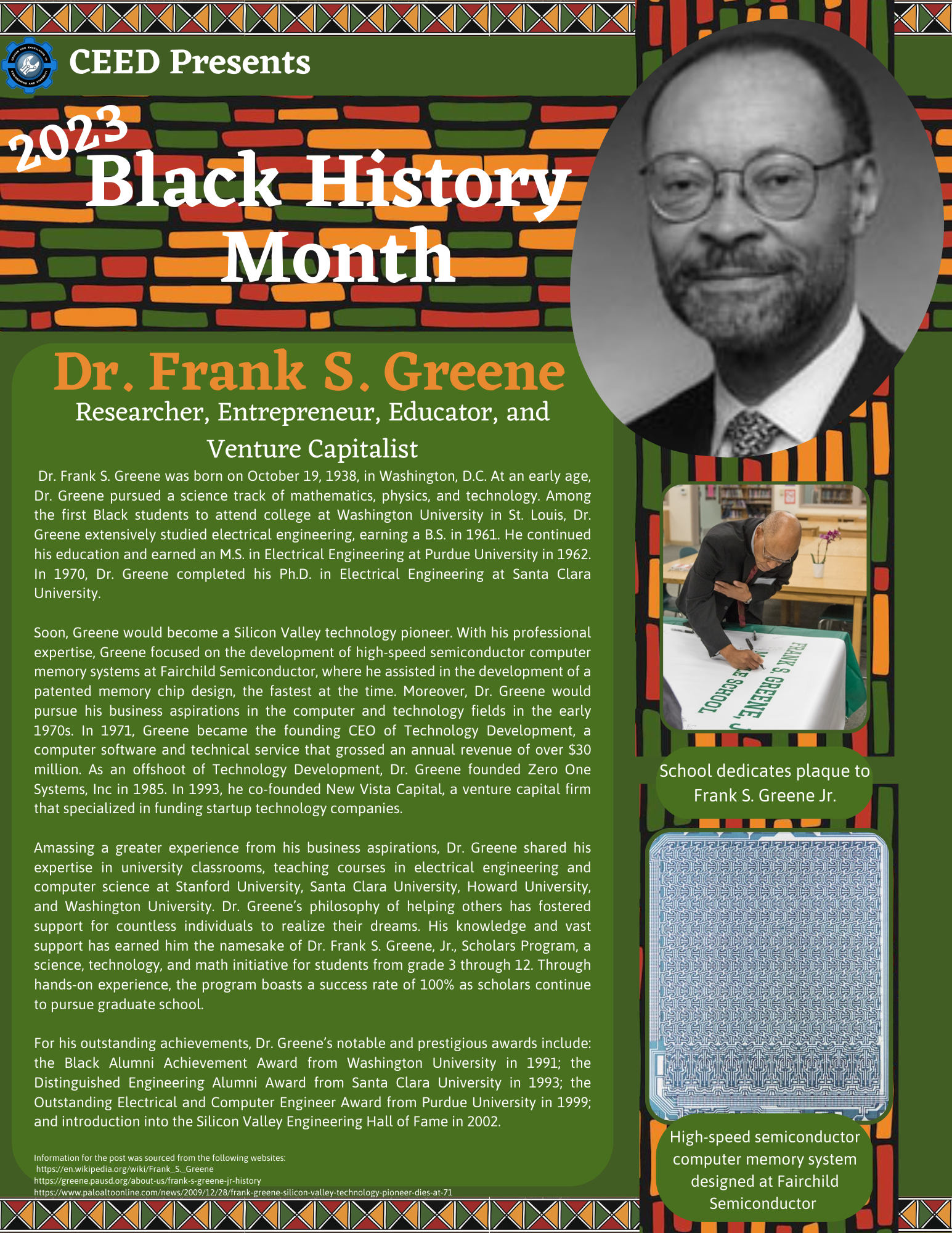
BHM Flyer for Dr. Frank S. Greene. Contains the following information: Dr. Frank S. Greene was born on October 19, 1938, in Washington, D.C. At an early age, Dr. Greene pursued a science track of mathematics, physics, and technology. Among the first Black students to attend college at Washington University in St. Louis, Dr. Greene extensively studied electrical engineering, earning a B.S. in 1961. He continued his education and earned an M.S. in Electrical Engineering at Purdue University in 1962. In 1970, Dr. Greene completed his Ph.D. in Electrical Engineering at Santa Clara University. Soon, Greene would become a Silicon Valley technology pioneer. With his professional expertise, Greene focused on the development of high-speed semiconductor computer memory systems at Fairchild Semiconductor, where he assisted in the development of a patented memory chip design, the fastest at the time. Moreover, Dr. Greene would pursue his business aspirations in the computer and technology fields in the early 1970s. In 1971, Greene became the founding CEO of Technology Development, a computer software and technical service that grossed an annual revenue of over $30 million. As an offshoot of Technology Development, Dr. Greene founded Zero One Systems, Inc in 1985. In 1993, he co-founded New Vista Capital, a venture capital firm that specialized in funding startup technology companies. Amassing a greater experience from his business aspirations, Dr. Greene shared his expertise in university classrooms, teaching courses in electrical engineering and computer science at Stanford University, Santa Clara University, Howard University, and Washington University. Dr. Greene’s philosophy of helping others has fostered support for countless individuals to realize their dreams. His knowledge and vast support has earned him the namesake of Dr. Frank S. Greene, Jr., Scholars Program, a science, technology, and math initiative for students from grade 3 through 12. Through hands-on experience, the program boasts a success rate of 100% as scholars continue to pursue graduate school. For his outstanding achievements, Dr. Greene’s notable and prestigious awards include: the Black Alumni Achievement Award from Washington University in 1991; the Distinguished Engineering Alumni Award from Santa Clara University in 1993; the Outstanding Electrical and Computer Engineer Award from Purdue University in 1999; and introduction into the Silicon Valley Engineering Hall of Fame in 2002. Information for the post was sourced from the following websites: https://en.wikipedia.org/wiki/Frank_S._Greene https://greene.pausd.org/about-us/frank-s-greene-jr-history https://www.paloaltoonline.com/news/2009/12/28/frank-greene-silicon-valley-technology-pioneer-dies-at-71
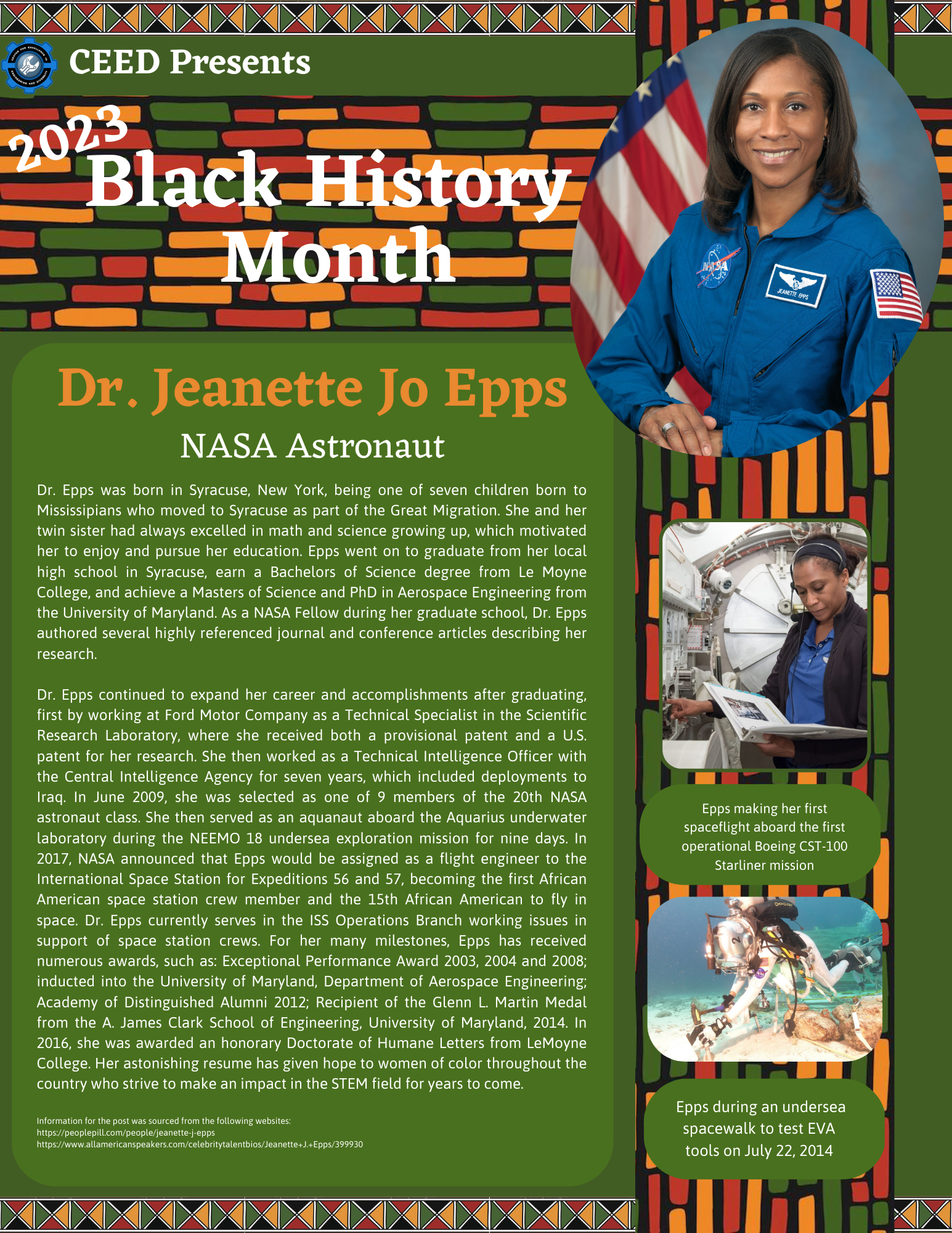
BHM Flyer about Dr. Jeanette Jo Epps. Contains the following information: Dr. Epps was born in Syracuse, New York, being one of seven children born to Mississipians who moved to Syracuse as part of the Great Migration. She and her twin sister had always excelled in math and science growing up, which motivated her to enjoy and pursue her education. Epps went on to graduate from her local high school in Syracuse, earn a Bachelors of Science degree from Le Moyne College, and achieve a Masters of Science and PhD in Aerospace Engineering from the University of Maryland. As a NASA Fellow during her graduate school, Dr. Epps authored several highly referenced journal and conference articles describing her research. Dr. Epps continued to expand her career and accomplishments after graduating, first by working at Ford Motor Company as a Technical Specialist in the Scientific Research Laboratory, where she received both a provisional patent and a U.S. patent for her research. She then worked as a Technical Intelligence Officer with the Central Intelligence Agency for seven years, which included deployments to Iraq. In June 2009, she was selected as one of 9 members of the 20th NASA astronaut class. She then served as an aquanaut aboard the Aquarius underwater laboratory during the NEEMO 18 undersea exploration mission for nine days. In 2017, NASA announced that Epps would be assigned as a flight engineer to the International Space Station for Expeditions 56 and 57, becoming the first African American space station crew member and the 15th African American to fly in space. Dr. Epps currently serves in the ISS Operations Branch working issues in support of space station crews. For her many milestones, Epps has received numerous awards, such as: Exceptional Performance Award 2003, 2004 and 2008; inducted into the University of Maryland, Department of Aerospace Engineering; Academy of Distinguished Alumni 2012; Recipient of the Glenn L. Martin Medal from the A. James Clark School of Engineering, University of Maryland, 2014. In 2016, she was awarded an honorary Doctorate of Humane Letters from LeMoyne College. Her astonishing resume has given hope to women of color throughout the country who strive to make an impact in the STEM field for years to come. Information for the post was sourced from the following websites: https://peoplepill.com/people/jeanette-j-epps https://www.allamericanspeakers.com/celebritytalentbios/Jeanette+J.+Epps/399930
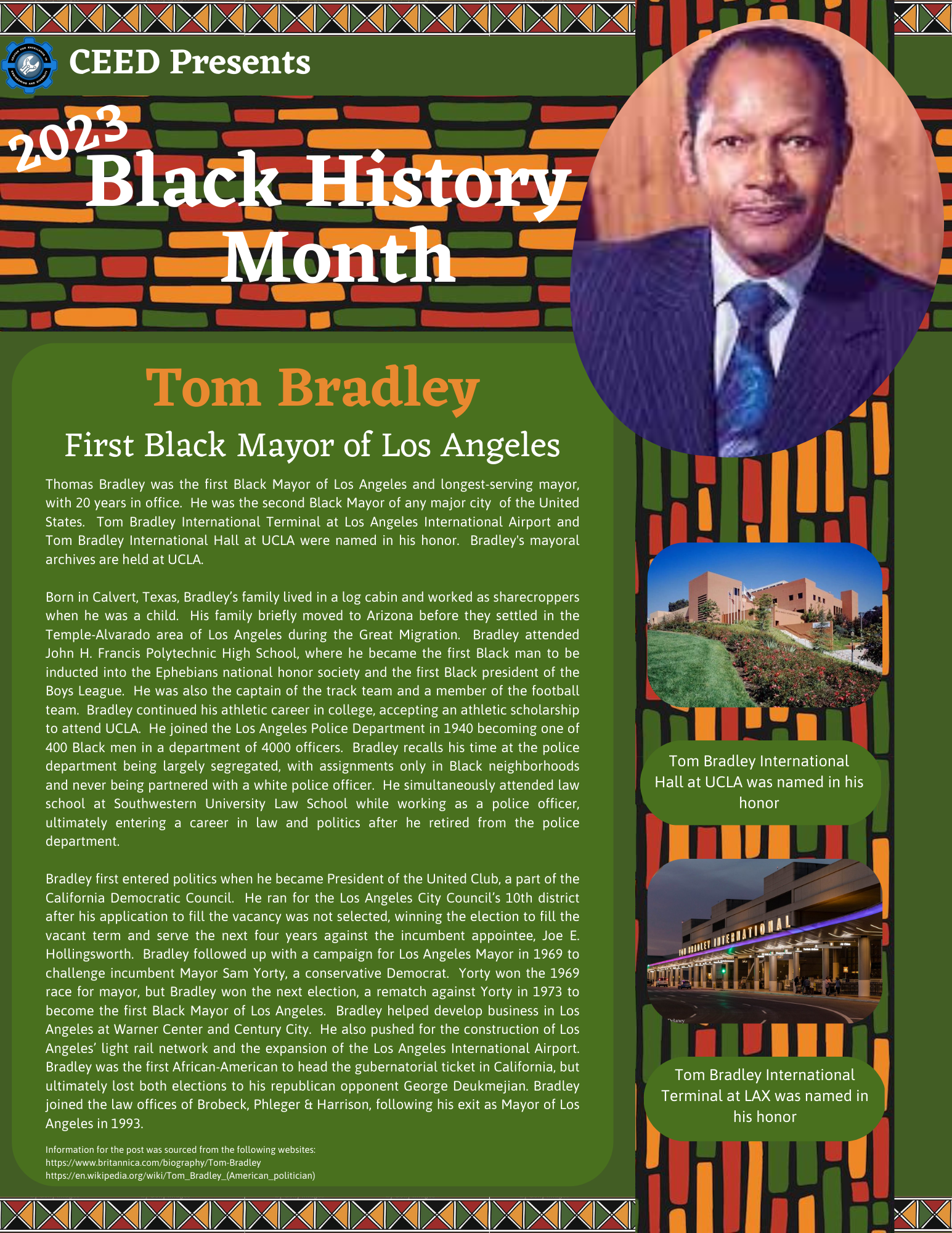
BHM Flyer for Tom Bradley. Contains the following information: Thomas Bradley was the first Black Mayor of Los Angeles and longest-serving mayor, with 20 years in office. He was the second Black Mayor of any major city of the United States. Tom Bradley International Terminal at Los Angeles International Airport and Tom Bradley International Hall at UCLA were named in his honor. Bradley's mayoral archives are held at UCLA. Born in Calvert, Texas, Bradley’s family lived in a log cabin and worked as sharecroppers when he was a child. His family briefly moved to Arizona before they settled in the Temple-Alvarado area of Los Angeles during the Great Migration. Bradley attended John H. Francis Polytechnic High School, where he became the first Black man to be inducted into the Ephebians national honor society and the first Black president of the Boys League. He was also the captain of the track team and a member of the football team. Bradley continued his athletic career in college, accepting an athletic scholarship to attend UCLA. He joined the Los Angeles Police Department in 1940 becoming one of 400 Black men in a department of 4000 officers. Bradley recalls his time at the police department being largely segregated, with assignments only in Black neighborhoods and never being partnered with a white police officer. He simultaneously attended law school at Southwestern University Law School while working as a police officer, ultimately entering a career in law and politics after he retired from the police department. Bradley first entered politics when he became President of the United Club, a part of the California Democratic Council. He ran for the Los Angeles City Council’s 10th district after his application to fill the vacancy was not selected, winning the election to fill the vacant term and serve the next four years against the incumbent appointee, Joe E. Hollingsworth. Bradley followed up with a campaign for Los Angeles Mayor in 1969 to challenge incumbent Mayor Sam Yorty, a conservative Democrat. Yorty won the 1969 race for mayor, but Bradley won the next election, a rematch against Yorty in 1973 to become the first Black Mayor of Los Angeles. Bradley helped develop business in Los Angeles at Warner Center and Century City. He also pushed for the construction of Los Angeles’ light rail network and the expansion of the Los Angeles International Airport. Bradley was the first African-American to head the gubernatorial ticket in California, but ultimately lost both elections to his republican opponent George Deukmejian. Bradley joined the law offices of Brobeck, Phleger & Harrison, following his exit as Mayor of Los Angeles in 1993. Information for the post was sourced from the following websites: https://www.britannica.com/biography/Tom-Bradley https://en.wikipedia.org/wiki/Tom_Bradley_(American_politician)

(click to enlarge)

  • LinkedIn
  • Donate to CEED
Engineer Change.
  • Facebook
  • X
© Copyright 2026 UCLA Samueli School Of Engineering
  • Contact Us
  • Accessibility
  • Terms of Use
  • Safety First
  • UCLA
We use cookies to understand how you use our site and to improve your experience, including personalizing content and to store your content preferences. If you would prefer, you may set your browser to refuse cookies or alert you when cookies are being sent. However, it is possible that some parts of our sites will not function properly if you do so. By continuing to use our sites, you accept our use of cookies and Terms of Use.
I ACCEPT